Author: George

  • Why Gift Bags Fail: A Guide to Paper Weight, Handles, and Load

    Why Gift Bags Fail: A Guide to Paper Weight, Handles, and Load

    A gift bag has exactly one structural job: to survive being filled, lifted, and carried without giving out. When one fails, it almost always fails in the same few places — a handle pulls free, the base splits, or the top edge tears where fingers dug in. None of that is bad luck. It is the predictable result of a paper weight, a handle style, or a base construction that was under-specified for the load. This guide walks through where the strength actually comes from, so you can order a bag that matches what you plan to put in it rather than discovering the mismatch at the counter.

    Start with paper weight

    Paper weight, measured in grams per square meter, is the foundation every other strength decision sits on. As a rough map of the market, lightweight gift bags run around 120 gsm and suit small, light contents; standard retail bags sit near 150 gsm; premium retail bags step up to about 200 gsm; and luxury or boutique bags commonly land in the 250 to 300 gsm range, where the paper feels almost board-like and holds a crisp fold. Heavier paper resists tearing and keeps its shape when a bag is only partly full, which is part of why upscale brands pay for it. The trade-offs are real, though: heavier stock costs more per bag, folds less cleanly on tight gussets, and adds shipping weight across a large order. The goal is not the heaviest paper available but the lightest weight that comfortably carries your contents. Paper type matters alongside weight, too: virgin kraft is generally stronger and tears less readily than the same weight in recycled stock, so a sustainability choice can quietly cost you some strength unless you step the gsm up to compensate.
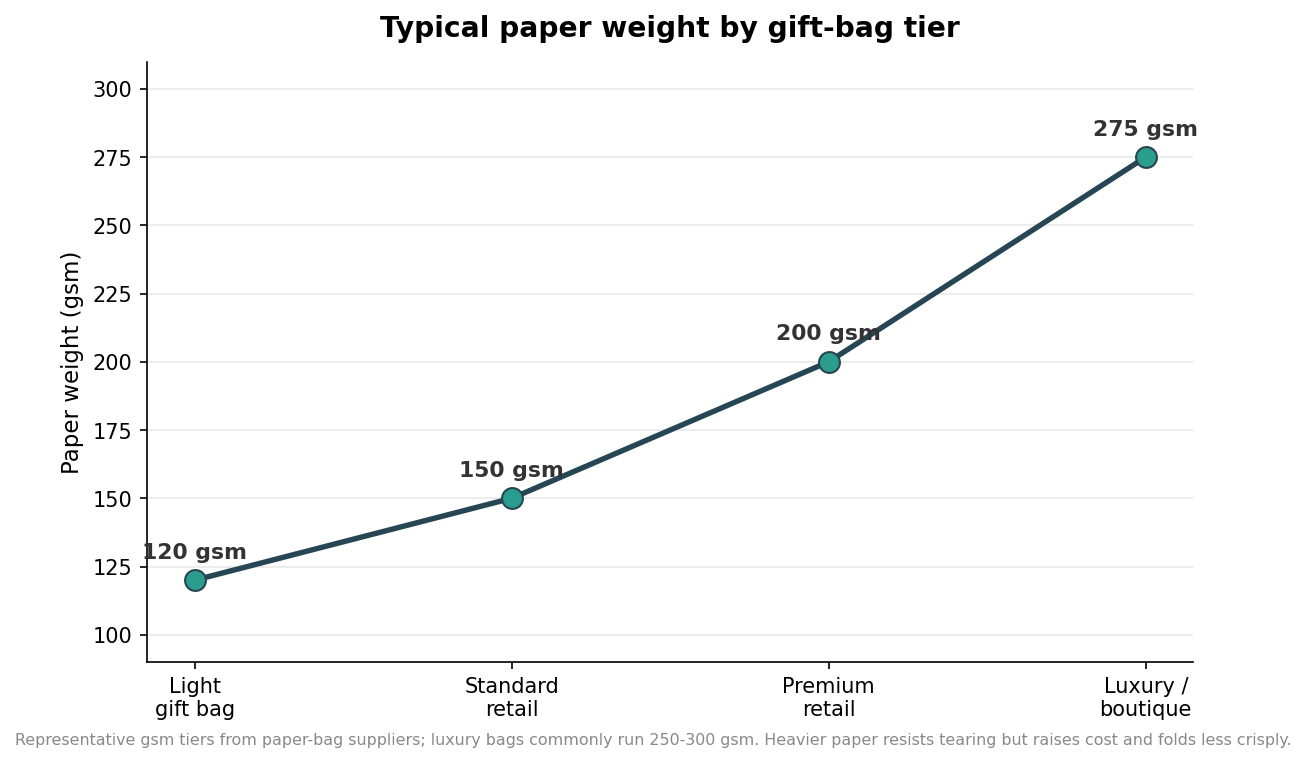
    Line chart of typical paper weight by gift bag tier: light 120 gsm, standard 150 gsm, premium 200 gsm, luxury 275 gsm
    Paper weight climbs from light gift bags to luxury boutique bags; match the weight to the contents, not to the top of the range.

    Handles carry the load, and they fail first

    The handle is the single most common failure point, because it concentrates the entire weight of the bag onto two small attachment areas. Ribbon handles are essentially decorative and belong on light, pretty packages. Flat paper and die-cut punch handles handle modest weights and keep costs and thickness down, which is why they dominate low-cost retail. Twisted paper handles are the workhorse of general retail: machine-applied, comfortable to hold, and good for everyday loads. Cotton rope handles sit at the top for strength and for perceived value, which is why they define the luxury boutique bag — but only when they are anchored properly. How a handle is attached matters as much as its type: a rope handle knotted through the wall with a reinforcing patch behind it will outlast one simply glued to the inside face. Ask how handles are fixed, not just what they are made of. It also helps to load a bag so the weight sits low and centered rather than swinging from one side, since an off-center load puts most of the strain on a single handle anchor.
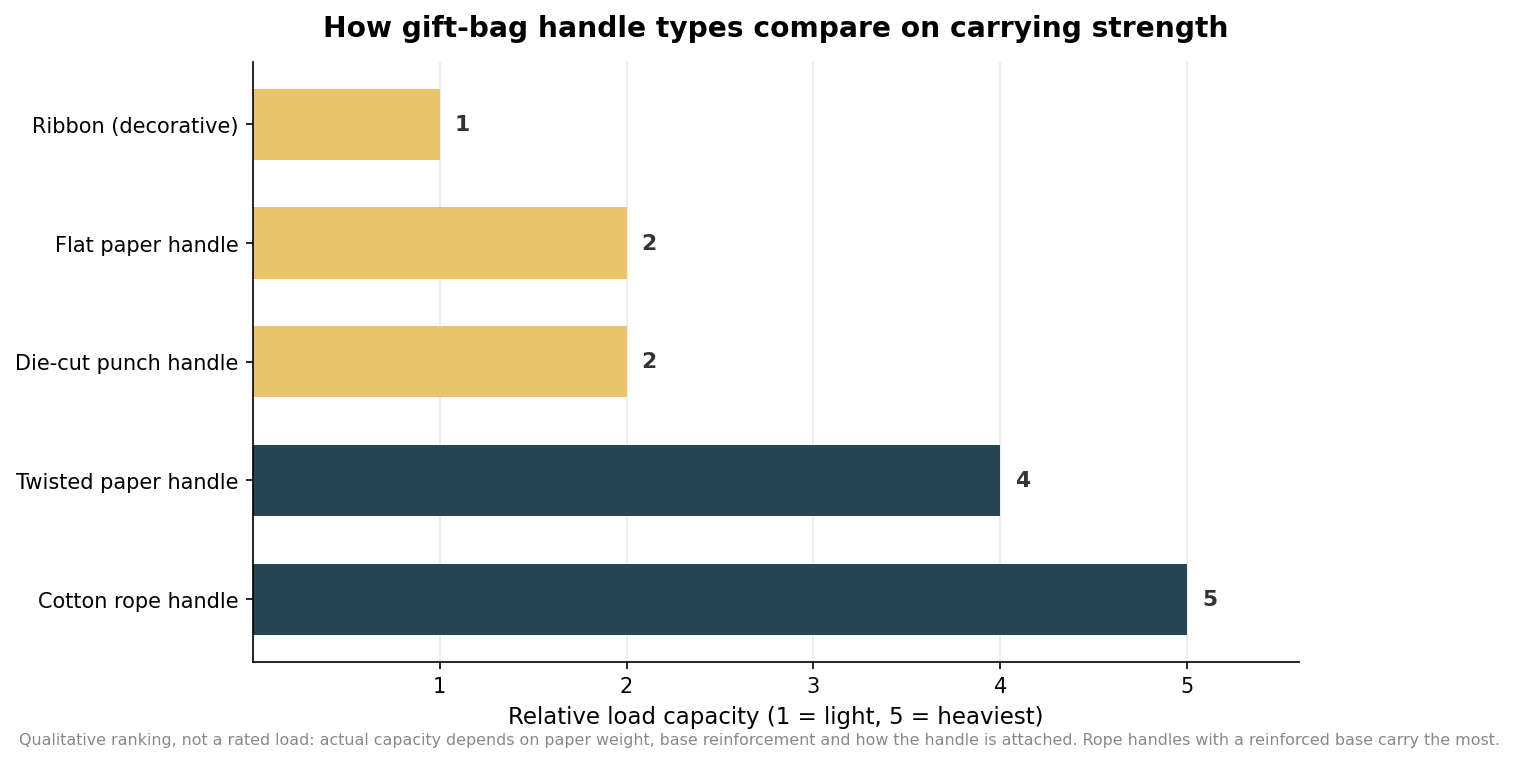
    Horizontal bar chart ranking gift bag handle types by relative load capacity, with cotton rope strongest and ribbon weakest
    Handles are the first thing to fail; rope handles carry the most, but only when anchored with a reinforcing patch.

    The base and the top edge do the quiet work

    Two unglamorous features quietly decide whether a bag survives a heavy load. The first is the base. A plain folded bottom will bow and eventually split under weight, so bags built for anything substantial include a base insert — a stiff card dropped into the bottom that spreads the load and keeps the footprint square. The second is the top edge. A raw cut edge is where tears start; a turned-over hem, where the paper is folded back on itself and glued along the opening, roughly doubles the paper at the most-handled line and resists the finger-tearing that kills lesser bags. Glued side and bottom seams are the third quiet factor, and a wide, well-bonded seam is far less likely to peel than a narrow one. When you compare quotes, these construction details — base insert, turned top edge, seam width — explain most of the price gap between two bags that look identical flat.

    Lamination changes durability, not just looks

    A film lamination is usually sold as a finish, but it is also a structural and protective upgrade. A matte or gloss laminate adds a measure of tear and scuff resistance and, importantly, a degree of moisture resistance — useful if bags may sit in a damp entryway, travel in the rain, or hold anything that can sweat or weep. The trade-off is that laminated bags are harder to recycle and slower to break down than an uncoated kraft bag, so if a recycled or compostable story matters to your brand, weigh that against the durability gain. For many buyers the honest answer is to laminate only the lines that need it and leave everyday bags uncoated.

    Match the bag to what goes in it

    Strength is only ever relative to the contents, so specify from the load backward. Small, dense, heavy items — a stack of candles, a bottle, hardware — punish handles and bases, so they call for heavier paper, a base insert, and rope or well-anchored twisted handles. Large but light contents — apparel, soft goods — are forgiving on weight but need enough bag size and stiffness that they don’t slump. Sharp or cornered items want a rigid bag or interior protection so a corner doesn’t punch through the wall. And anything damp, greasy, or refrigerated points toward a laminate or a poly-lined option. Decide the heaviest, most awkward thing the bag will ever carry, spec for that, and the everyday cases take care of themselves. A bag that costs a few cents more but never fails in a customer’s hand is the cheaper bag in the end.
  • How Custom Gift Bags Are Printed: Choosing the Right Process for Your Run

    How Custom Gift Bags Are Printed: Choosing the Right Process for Your Run

    Most people start a custom gift bag order from the artwork and work outward. The printer starts from a different place: how many bags you need and what the design demands. Those two questions decide which printing process makes sense, and the process in turn shapes your cost, your minimum order, and how faithfully your logo lands on the bag. If you understand the four common methods before you request a quote, you can specify a bag that looks right and prices right instead of paying premium-process money for a job a cheaper method would have nailed.

    Start with the run size, not the logo

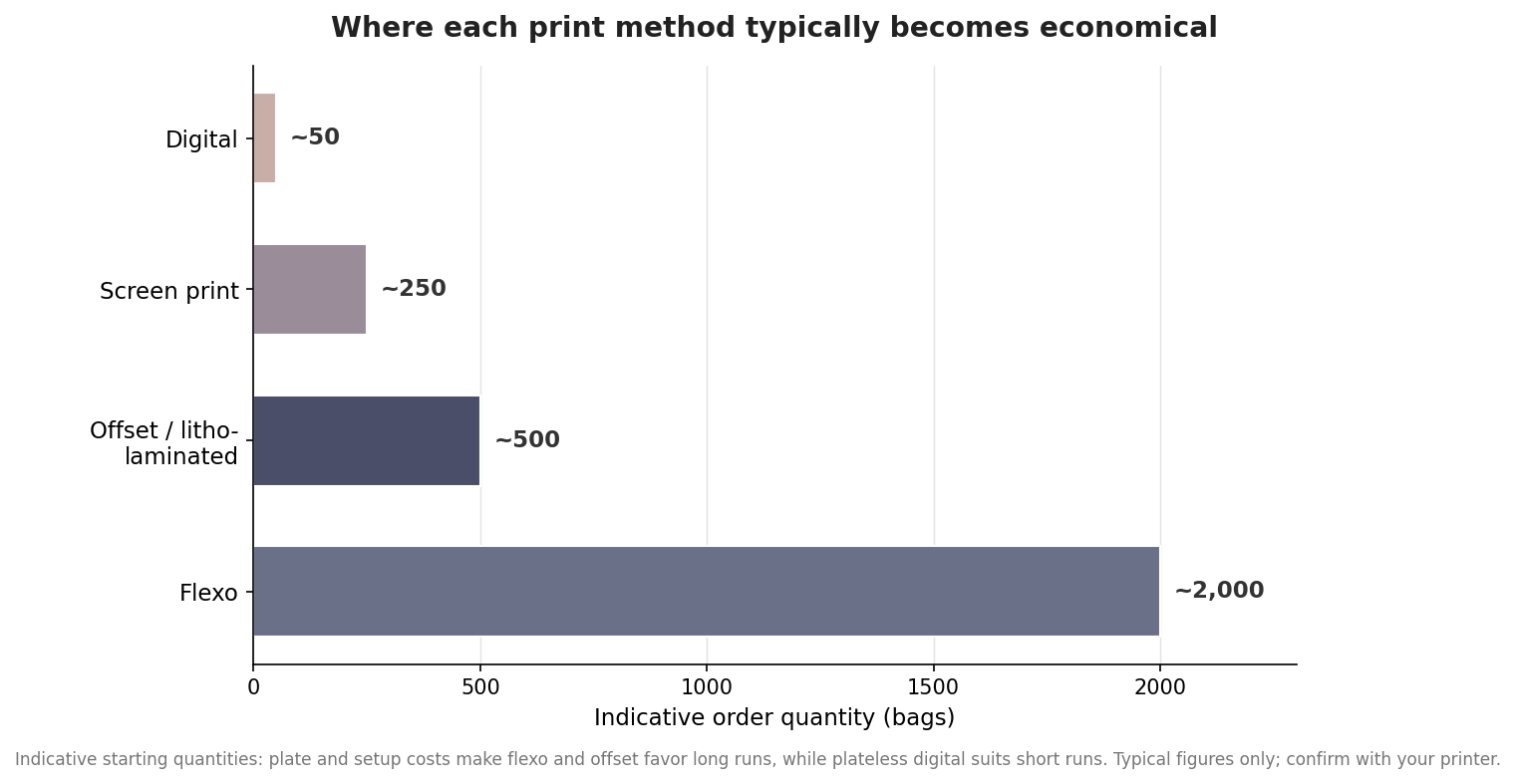
    Every printing method carries a fixed setup cost and a per-bag cost, and the balance between them is what decides the economical choice. Methods that need a physical plate or die spread that setup over the run, so they only get cheap once the quantity is large. Plateless methods skip the setup but cost more per unit, which makes them the sensible pick for short runs. Before comparing looks, place your order on that spectrum, because a beautiful process at the wrong volume is simply an expensive one.

    Horizontal bar chart of the indicative order quantity where each print method becomes economical: about 50 for digital, 250 for screen, 500 for offset, and 2,000 for flexo
    Roughly where each method turns economical; setup cost pushes flexo and offset toward long runs.

    The four ways a bag gets printed

    Flexography, or flexo, presses ink from a flexible raised plate directly onto the paper, usually the unbleached kraft used for grocery-style and everyday retail bags. It is fast and, at high volume, the cheapest option per bag. The trade-off is detail: flexo handles bold logos and a few solid spot colors well, but it struggles with fine lines, small text, soft gradients, and photographic images. It is the right call when you are ordering thousands of bags with a clean, simple mark.

    Offset, most often delivered as litho-lamination, prints your art with high fidelity onto a sheet that is then laminated to the bag. This is the process behind glossy, full-color boutique and gift bags, because it reproduces small text, fine lines, gradients, and full-color artwork cleanly. The catch is setup: plates and lamination raise both the cost and the lead time, so offset rewards larger premium runs rather than a quick fifty-bag job.

    Digital printing uses no plate at all, so there is little setup cost and turnaround is quick. That makes it the natural fit for short runs, test batches, and jobs with changing artwork, and it now handles full color respectably. Its weakness is scale: because the per-bag cost barely drops with volume, digital loses to flexo and offset once you are into the thousands.

    Screen printing pushes ink through a mesh stencil and lays down thick, vivid spot color, which looks especially good as a one- or two-color logo on a natural kraft bag. It sits in the middle on setup and does not reproduce gradients or photographs, so it suits bold, limited-color branding on small to medium runs rather than detailed imagery.

    Finishes are a separate decision

    Foil stamping and embossing are not printing methods; they are finishing steps applied on top of, or instead of, printing, and they each need their own tooling. Foil stamping presses metallic foil from a heated die and is built for logos and short brand names rather than full images, with a minimum line thickness so fine details do not drop out. Embossing uses a matched pair of molds to press a raised, tactile shape into the paper, which reads as premium but needs a thicker stock to hold the impression and does not carry complex detail. Both add cost and production time, and both push you toward heavier paper, which is why the finish you want and the paper weight you choose are really one decision.

    Choosing the paper weight

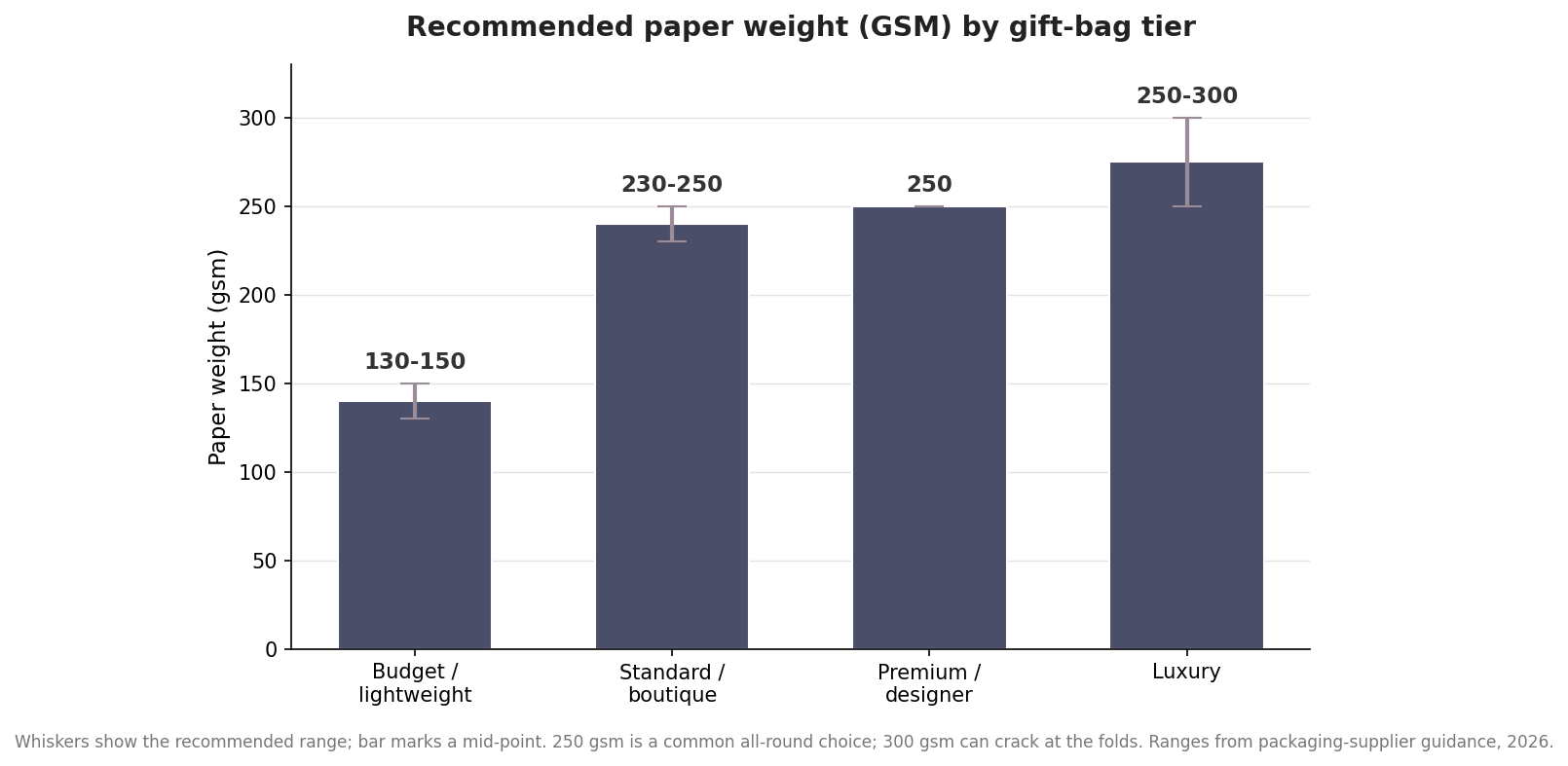
    Paper weight is measured in grams per square meter, or gsm, and it governs how sturdy the bag feels and how much it can carry. Lighter kraft bags around 130 to 150 gsm are the cost-efficient choice for light contents such as folded apparel, but they are not built for heavy items or for decorative finishing. Standard retail and boutique bags typically move up to the 230 to 250 gsm range, where the bag feels substantial and can take basic foil work. Around 250 gsm is the common all-round sweet spot: it offers strong load capacity, handles heavier or multiple items, and works with virtually any finish. Luxury bags run from 250 up toward 300 gsm on white or specialty stock for the richest hand.

    Bar chart of recommended paper weight in gsm by gift-bag tier: 130-150 budget, 230-250 boutique, about 250 premium, and 250-300 luxury
    Recommended paper weight by tier; around 250 gsm is the common all-round choice.

    It is tempting to assume heavier is always better, but that is where buyers overspend. Pushing to 300 gsm buys little real strength over 250 and introduces a practical problem: the very stiff board is prone to cracking along the fold lines during manufacturing, which can leave visible white lines on a dark printed bag. Unless you specifically need the heft of a flagship-store bag, 250 gsm is usually the smarter ceiling.

    Putting the spec together

    Work in order. First, fix the quantity and let it point you toward a process: a short, colorful run leans digital, a bold-logo kraft run in the thousands leans flexo, a limited-color logo on kraft suits screen, and a large full-color premium run calls for offset litho-lamination. Second, decide whether the design truly needs photographic detail or gradients, since that requirement alone can rule out flexo and screen regardless of quantity. Third, choose the paper weight from the contents and the finish, defaulting to around 250 gsm unless the bag will carry very light or unusually heavy loads. Bring those three answers to your printer instead of only a logo file, and the quote you get back will match the bag you actually pictured, at a price that reflects the job rather than the fanciest process on the menu.

  • How to Choose Custom Gift Bags for Your Brand

    How to Choose Custom Gift Bags for Your Brand

    How to Choose Custom Gift Bags for Your Brand: Use Cases and Ordering

    The best way to choose custom gift bags is to start from how they will be used, then work back to the material, size, and decoration that fit. Custom gift bags serve very different jobs across retail & boutiques, events & gifting, food & specialty, and promotions, and matching the order to the job is what makes custom gift bags feel purpose-built rather than generic. This guide maps the common use cases and walks through ordering custom gift bags that fit your brand.

    Whether the gift bags protects a product, presents a gift, or carries a logo into the world, defining that job first keeps every later decision easy. Purpose drives the spec, and the spec drives the result.

    How brands use custom gift bags

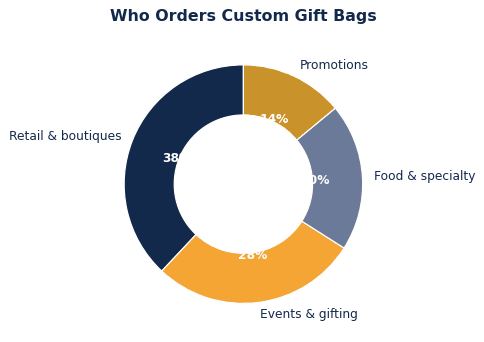
    Custom gift bags get ordered for a mix of protection, presentation, and promotion, and knowing where yours fall points you to the right build. The breakdown below shows the common uses, from retail & boutiques to promotions.

    The common ways brands put custom gift bags to work.
    The common ways brands put custom gift bags to work.

    Most orders lean toward one primary job with a secondary benefit — a shipping-focused gift bags that also brands the unboxing, or a gift-focused one that also protects. Naming your primary use keeps the order focused and the spec appropriate.

    Use case What it needs
    Retail & boutiques branded carry-out that markets the store
    Events & gifting take-home bags guests keep and reuse
    Food & specialty product-appropriate bags sized to the item
    Promotions reusable bags that keep a logo in circulation

    Matching material and size to the use

    Once the use is clear, the material and size follow. A protection-first job favors a durable, well-fitted build; a presentation-first job favors a premium material and a clean print; a promotion-first job favors a cost-effective option you can order in volume. Sizing to the product with a small margin keeps the gift bags looking intentional and performing its job.

    If a single order serves more than one use, spec to the most demanding one so the gift bags performs everywhere. It is easier to use a slightly sturdier or more premium gift bags across the board than to discover a bargain option falls short for your most important use case.

    Branding for the impression you want

    Decoration should reinforce the impression the use calls for. Screen printing suits bold one- or two-color logos, while full-color printing wraps detailed art edge to edge. For a premium or gift use, lean on finishes and restraint; for high-volume promotion, prioritize a bold, legible logo that reads at a glance and reproduces affordably at scale. Keep branding consistent with the rest of your packaging or merch so everything reads as one system.

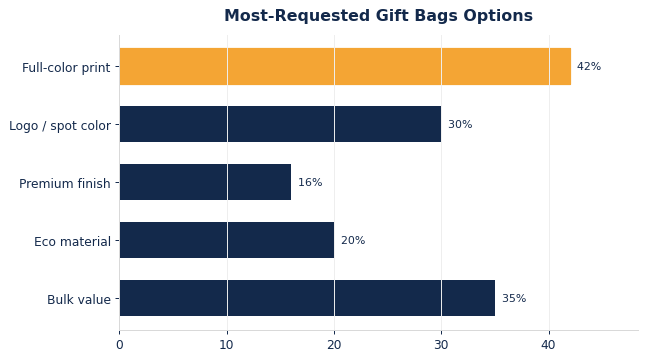
    The most-requested options below reflect what buyers reach for most, and they are a useful starting menu when you brief your order. Whatever you choose, approve a proof so the finished custom gift bags match the impression you intended.

    The options buyers request most on custom gift bags.
    The options buyers request most on custom gift bags.

    Getting the size and details right

    Even with the use and material decided, the details are what make custom gift bags feel finished. Confirm the size and gusset against the product with a small margin, check the print area for your chosen size so the logo sits cleanly, and decide on any finishing touches before you brief the order. These small confirmations up front are what separate a gift bags that looks intentional from one that looks close-enough.

    A sample or proof is the cheapest insurance you can buy on a gift bags order. A physical sample lets you judge the material and print in hand, while a digital proof confirms artwork, color, and size and gusset before the full run. Spending a few minutes here prevents the far larger cost of reworking a finished order of custom gift bags that missed on a detail.

    Ordering: quantities, lead time, and reorders

    A smooth gift bags order comes down to a few basics: order for real demand plus a small overage, send print-ready artwork early, and confirm lead time against any deadline so production and shipping fit your timeline. Per-unit cost drops with volume, so consolidating a season’s needs into one run is usually more efficient than repeated small orders.

    Keep your approved artwork and spec on file so reorders are a quick repeat rather than a fresh setup each time — consistency across runs keeps your brand looking deliberate.

    Coordinating with the rest of your brand

    Custom gift bags rarely stand alone; they sit alongside your other packaging, print, or merch, so coordinating them strengthens the whole brand. Carrying the same logo, colors, and tone across your gift bags and your other pieces makes everything read as one deliberate system rather than a set of one-off orders. That consistency is what makes a brand feel established, and it costs nothing extra to plan.

    Coordination also simplifies buying over time. Standardizing on a material, size, and decoration you are happy with turns future orders into simple repeats, and it keeps every batch matching the last. A little upfront alignment pays back every time you reorder custom gift bags.

    Frequently asked questions about custom gift bags

    What are custom gift bags used for?

    Custom gift bags serve a mix of protection, presentation, and promotion across retail & boutiques, events & gifting, food & specialty, and promotions. Most orders lean toward one primary job with a secondary benefit, so naming your main use is the first step in speccing the right gift bags.

    How do I match custom gift bags to my use?

    Let the use drive the spec: durable and well-fitted for protection, premium and clean for presentation, cost-effective and bold for promotion. If one order serves several uses, spec to the most demanding one so the gift bags performs everywhere.

    How should I brand custom gift bags?

    Screen printing suits bold one- or two-color logos, while full-color printing wraps detailed art edge to edge. Choose finishes and restraint for premium or gift uses, and a bold, legible logo for high-volume promotion, keeping the branding consistent with your other packaging or merch so it all reads as one system.

    How far ahead should I order custom gift bags?

    Order for real demand plus a small overage, send print-ready artwork early, and confirm lead time against any deadline so production and shipping fit your timeline. Consolidating a season’s needs into one run is usually more efficient than repeated small orders.

    Can I reorder easily?

    Yes. Keeping your approved artwork and spec on file makes reorders a quick repeat rather than a fresh setup, and it keeps every batch of custom gift bags matching the last for a consistent brand look.

    Do I need a sample before ordering custom gift bags?

    A sample is worth it for a first order or a new material, since judging feel and print in hand removes the guesswork. For a straightforward reorder of custom gift bags you have bought before, a digital proof confirming artwork and size and gusset is usually enough.

    Match the gift bags to the job, spec it deliberately, and approve a proof, and your order will do exactly what you needed. For the full material and sizing breakdown, see our companion guide, our Custom Gift Bags: Materials, Sizing & Branding Guide, and browse our our shop to get started.

    Not sure which custom gift bags fit your use?

    Tell us how you’ll use them and we’ll match the material, size, and branding to the job.

    Get a Quote

  • Custom Gift Bags: Materials, Sizing & Branding Guide

    Custom Gift Bags: Materials, Sizing & Branding Guide

    Custom Gift Bags: A Materials, Sizing, and Branding Guide

    Getting custom gift bags right comes down to three decisions: the material, the size or spec, and how you brand them. Make those well and you end up with custom gift bags that protect and present your product, reinforce your brand, and land on budget. This guide walks through the material options, how to size and spec your order, and how to decorate custom gift bags so they do real work for your brand rather than just checking a box.

    Whether you are ordering your first run or reordering at scale, the same fundamentals apply. Choosing custom gift bags deliberately — material to job, size to product, decoration to brand — is what separates an order you are proud of from one you settle for.

    Why custom gift bags matter for your brand

    Custom gift bags are more than a commodity; they are a touchpoint brands experience directly. A well-chosen, well-branded option signals quality and attention to detail, while a generic one quietly undercuts an otherwise strong product. Because custom gift bags are seen and handled, they carry your brand into the world every time they are used.

    That visibility is exactly why it pays to spec custom gift bags intentionally. The material sets the feel, the size sets the fit and cost, and the decoration sets the impression — and getting all three aligned turns a functional item into a genuine brand asset.

    Materials and options compared

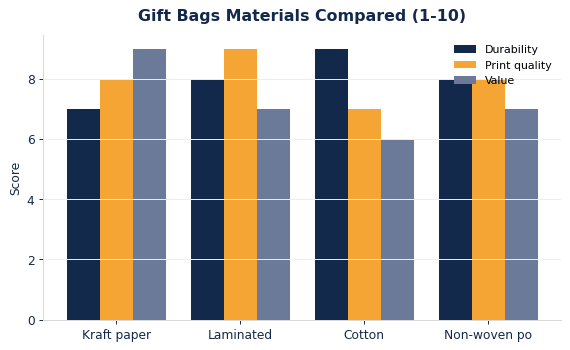
    The common materials for custom gift bags each trade off durability, print quality, and cost: kraft paper, laminated / matte film, cotton / canvas, and non-woven polypropylene. The right pick depends on how the gift bags will be used, the look you want, and your budget. The chart and table below compare the main options so you can match material to job.

    How common gift bags materials compare on durability, print quality, and value.
    How common gift bags materials compare on durability, print quality, and value.

    As a rule of thumb, choose a recyclable or natural material when eco positioning matters, a coated or laminated option when you want vivid full-color print, and a premium build when the gift bags is part of a gift or high-end presentation. When in doubt, request a sample so you can judge feel and print before committing to a full run.

    Material / option Best for
    Kraft paper recyclable and natural, ideal for eco positioning
    Laminated / matte film durable, moisture-resistant, premium finish
    Cotton / canvas reusable and sturdy for a keepsake feel
    Non-woven polypropylene low-cost, reusable, lightweight

    Sizing and specs

    Sizing is where many gift bags orders go wrong, so measure before you order. Custom gift bags typically range from a slim gift bag up to a wide gusseted grocery or retail bag, and the right size and gusset depends on the product or use they serve. Too small and the fit is tight or the product is exposed; too large and you pay for material you do not need and lose a clean, intentional look.

    When a measurement falls between standard options, size to the product with a small margin rather than guessing. Confirming the size and gusset on a proof or sample before a large run prevents the costly mistake of a full order that does not fit, which is far more expensive to fix than a five-minute check up front.

    Branding and decoration

    Decoration is what turns a plain gift bags into a branded one. Screen printing suits bold one- or two-color logos, while full-color printing wraps detailed art edge to edge. Match the method to your artwork and budget: simple logos reproduce cleanly and cheaply, while detailed, full-color designs shine with the right process on the right material. Keep the artwork vector where possible and confirm the print area for your chosen size.

    Restraint usually reads as premium. A clean logo, one or two brand colors, and quality material almost always look more considered than a busy, over-printed design. Approving a proof before the run protects both the look and the budget, especially on a large order of custom gift bags.

    Ordering and budget

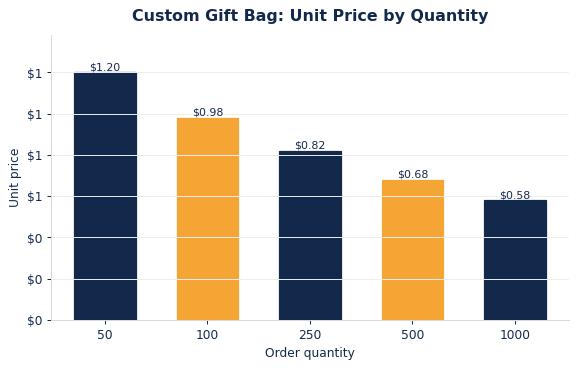
    Per-unit cost on custom gift bags falls steadily with volume as setup amortizes across more pieces, so ordering for real demand rather than a token first batch is usually the efficient move. The curve below shows how pricing typically improves with quantity, which helps you plan an order that balances cash and cost.

    Typical per-unit gift bags pricing as order quantity increases.
    Typical per-unit gift bags pricing as order quantity increases.
    Ordering for a recurring need? A single larger run lowers the unit cost and keeps your branding consistent, while a small overage covers reorders and the occasional damaged piece without a rush order.

    Common mistakes to avoid

    A few avoidable missteps account for most disappointing gift bags orders. Ordering before measuring is the biggest, followed by choosing a material for price alone without considering how the gift bags will actually be used, and skipping the proof on a large run. Each is easy to prevent with a few minutes of planning, and each is expensive to fix once a full order is produced.

    The other common trap is over-designing the artwork. Cramming in too many colors, effects, or details can muddy the print and raise the cost, especially on textured or recycled materials. Simplifying the design to a clean, legible mark almost always improves both the look and the price of your custom gift bags.

    Frequently asked questions about custom gift bags

    What material is best for custom gift bags?

    It depends on the use: choose a recyclable or natural material for eco positioning, a coated or laminated option for vivid full-color print, and a premium build for gifting or high-end presentation. Request a sample to judge feel and print before a full run of custom gift bags.

    How do I choose the right size?

    Measure the product or use the gift bags serves, then size to it with a small margin so the fit is clean without wasting material. When a measurement falls between standard options, size up slightly and confirm the size and gusset on a proof before ordering in volume.

    How are custom gift bags branded?

    Screen printing suits bold one- or two-color logos, while full-color printing wraps detailed art edge to edge. Match the method to your artwork and budget, keep the art vector where possible, confirm the print area for your size, and approve a proof so the finished custom gift bags match your intent.

    How does pricing work, and is there a minimum?

    Per-unit cost drops with quantity as setup amortizes across the run, so larger orders are more cost-effective. Order for real demand plus a small overage rather than a token batch, and consolidate recurring needs into one run for the best price.

    Can I get a sample or proof before ordering?

    Yes, and it is strongly recommended. A physical sample lets you judge material and print, and a digital or physical proof confirms your artwork, color, and size and gusset before a full run — a small step that prevents a costly mistake on a large order.

    What do you need to quote custom gift bags?

    To quote accurately we need the size and gusset or the product they serve, the quantity, your material preference, and your artwork or a description of the branding. With those details we can recommend the right material and size and give you pricing for the run, and a proof follows once the order is confirmed.

    Whatever you order, send vector artwork, confirm material and size and gusset, and approve a proof before production. For help matching custom gift bags to a specific use, see our companion guide, our How to Choose Custom Gift Bags for Your Brand, and explore our our shop to start your order.

    Ready to order custom gift bags?

    Tell us your product, quantity, and branding and we’ll match the material, size, and decoration for you.

    Get a Quote