Author: George

  • Euro Tote vs. SOS vs. Merchandise Bag: A Gift Bag Construction Comparison

    Euro Tote vs. SOS vs. Merchandise Bag: A Gift Bag Construction Comparison

    Most buyers choosing custom gift bags start with size and color and treat the bag’s construction as an afterthought. That is backwards. A bag’s build, the way its body, bottom, and handles are engineered, determines whether it looks like a boutique purchase or a giveaway, how much it can carry without tearing, and what it costs per unit before you print a single logo. Four construction styles cover the overwhelming majority of retail and event gift bags, and they are genuinely different products. Knowing how they differ lets you spend your budget where it shows and avoid paying tote prices for a job a simpler bag would do better.

    Four ways a gift bag is built

    The euro tote is the premium standard. It is made from a sheet of laminated art paper folded with a turned-over top hem for a clean rigid edge, stiffened with a cardboard bottom insert, and finished with rope or cotton-cord handles set through eyelets. That construction is what gives a euro tote its structured, holds-its-shape look on a shelf, and it is why it photographs like a luxury bag. The SOS bag, short for self-opening square, is the flat-bottomed grocery-style sack that stands up on its own. Usually kraft, with twisted or flat paper handles glued inside the top, it is built for sturdiness at a working price rather than for polish. The die-cut handle bag punches the handle directly into the top of the bag, backed by a reinforcing patch, which removes the cost of a separate handle and makes it a popular economical choice for events and trade shows. The flat merchandise bag is the simplest of all: a thin, often handleless sleeve for apparel, cards, and small goods handed across a counter. Each of these is a different answer to the same question, and the chart below shows the first place they diverge.

    What each style can actually carry

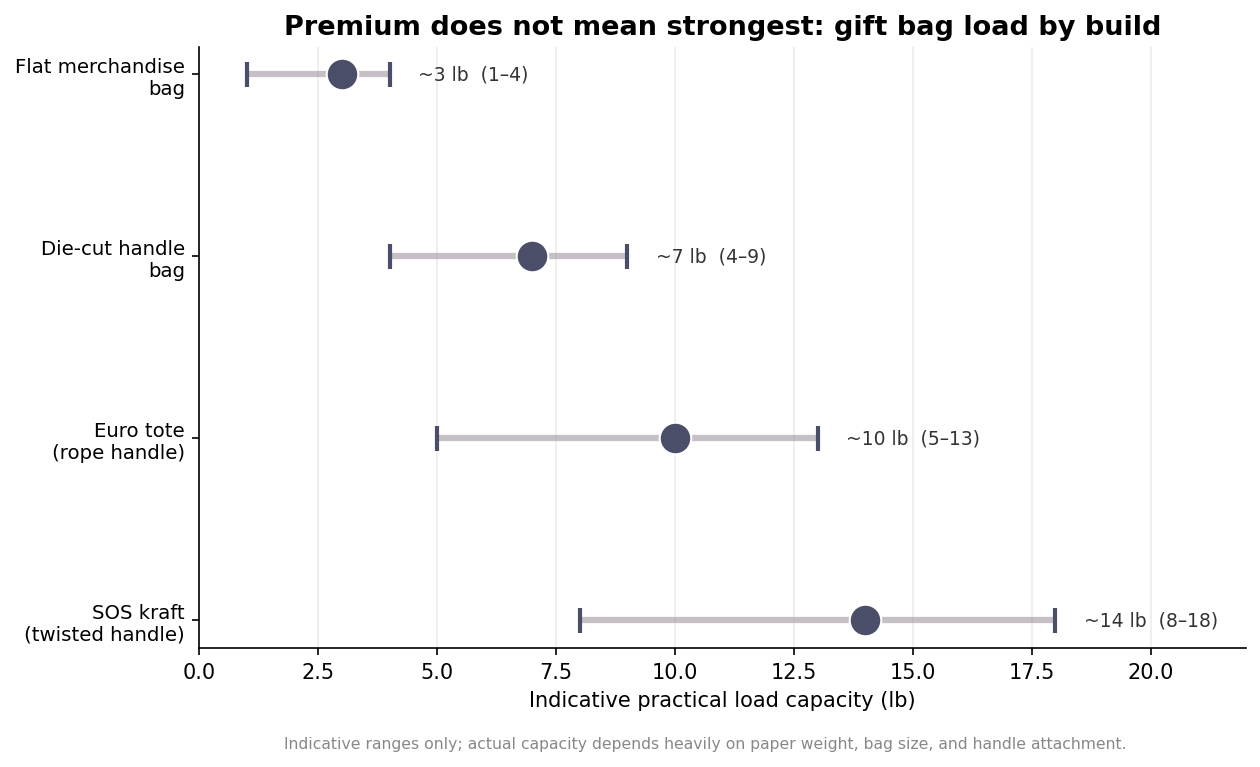
    Load capacity is where assumptions get expensive. Many buyers assume the euro tote, being the most premium, is also the strongest, and that is often not true. A euro tote’s weak point is its handle attachment: rope handles set in eyelets will pull out of an underbuilt bag before the paper itself fails, which caps practical load. A well-made kraft SOS bag with integrated twisted handles frequently carries more weight than a euro tote of the same footprint because the handle is bonded into the bag body across a wide glue area. The figures below are indicative ranges, not guarantees, because real capacity swings widely with paper weight, bag size, and handle quality.

    Dot plot of indicative load capacity in pounds for flat merchandise, die-cut handle, euro tote, and SOS kraft gift bags with ranges
    A twisted-handle kraft SOS bag often out-carries a premium euro tote of the same size.

    Read these as relative tendencies. A flat merchandise bag is a light-duty carrier and will split if you load it like a shopper; a die-cut handle bag handles moderate weight but concentrates stress at the punched hole, so it suits lighter, bulkier gifts rather than dense ones. If your product is genuinely heavy, specify a higher paper weight and a bonded handle regardless of which style you choose, and ask the supplier for a rated capacity in writing rather than trusting the look of the bag.

    Print, polish, and what you pay for it

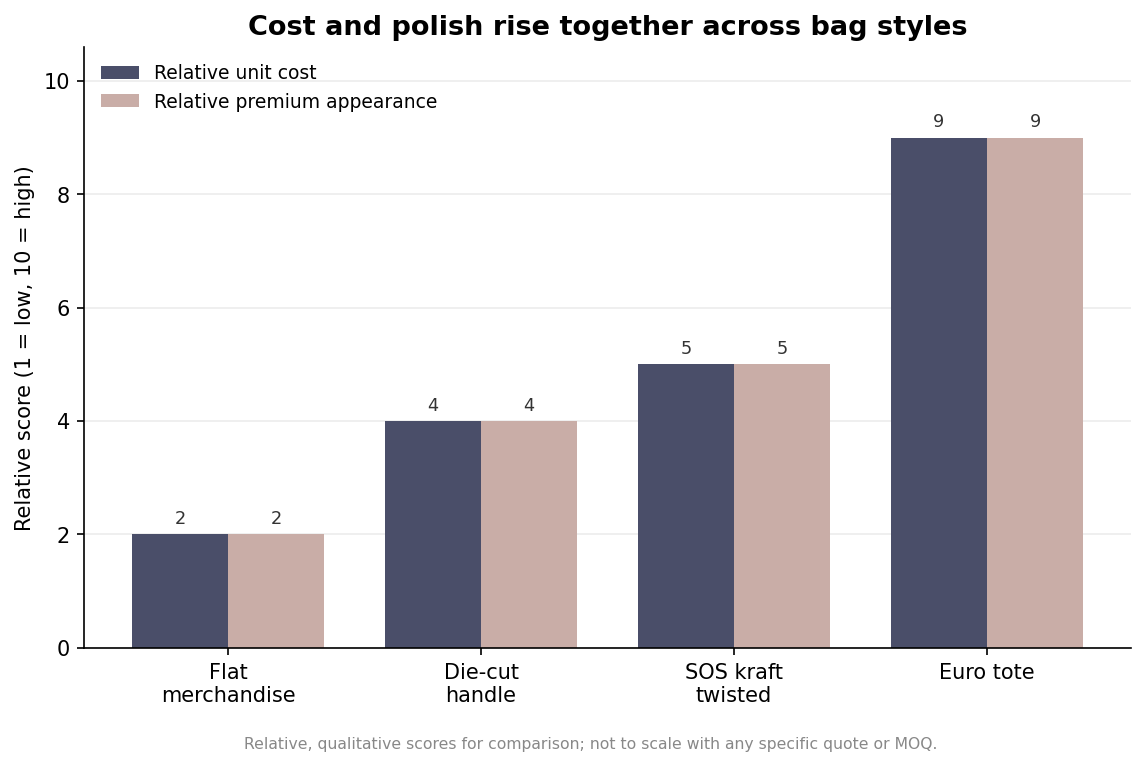
    Construction also decides how your branding lands and what the unit costs. The euro tote’s laminated surface is built for full-color, photographic graphics and finishes like matte or gloss film, soft-touch coating, and foil, which is why it dominates cosmetics, boutique retail, and premium gifting. That capability comes at a price: euro totes carry the highest unit cost of the four and typically the highest custom minimum order quantities, because they involve more material and more assembly steps. Kraft SOS bags lean into a natural, craft-forward look that pairs best with one or two-color printing and often reads as more authentic for food, market, and sustainably positioned brands. Die-cut and flat bags are the budget canvases, fine for a clean logo but not the place to expect gallery-quality reproduction. The comparison below sets relative cost against relative premium appearance.

    Grouped bar chart comparing relative unit cost and relative premium appearance across flat merchandise, die-cut handle, SOS kraft, and euro tote bags
    Unit cost and premium appearance climb together, so buy only as much polish as the occasion needs.

    The useful insight here is that cost and polish rise together, so the real question is how much polish the occasion actually requires. Paying euro tote prices for a bag that will be used once at a trade show and thrown away is a poor trade; so is putting a flagship product in a flat merchandise sleeve that undersells it at the counter. Match the spend to how long the bag will live and how much it is doing to represent the brand.

    Matching the build to the job

    For boutique retail, cosmetics, jewelry, and gifts where the bag is part of the unboxing and may be reused or seen again, the euro tote earns its premium and its higher minimum. For grocery, market, takeout, and any high-volume situation where sturdiness and a natural look matter more than gloss, a twisted-handle kraft SOS bag delivers the most carrying strength per dollar. For trade shows, conferences, and one-day events where you need a printed handled bag in quantity at a controlled cost, a die-cut handle bag is usually the smart middle ground. And for apparel, stationery, and light impulse purchases handed over at the register, a flat merchandise bag does the job without wasting money on structure the item does not need. Decide the construction first, then choose size, paper weight, and handle to match, and confirm a rated load and a printing method that suits the style before you approve your sample.

  • Custom Gift Bag Lead Times: How Far Ahead to Order

    Custom Gift Bag Lead Times: How Far Ahead to Order

    The single most expensive mistake on a custom gift bag order is not choosing the wrong paper or the wrong handle. It is ordering three weeks before you need the bags in hand and discovering that a printed, laminated, rope-handled bag made overseas takes closer to three months. Lead time is the part of the process buyers underestimate most, and it is almost entirely predictable once you know which stages your order has to pass through. This guide breaks the timeline into its real components so you can plan backward from the date you actually need the bags.

    The four stages every order passes through

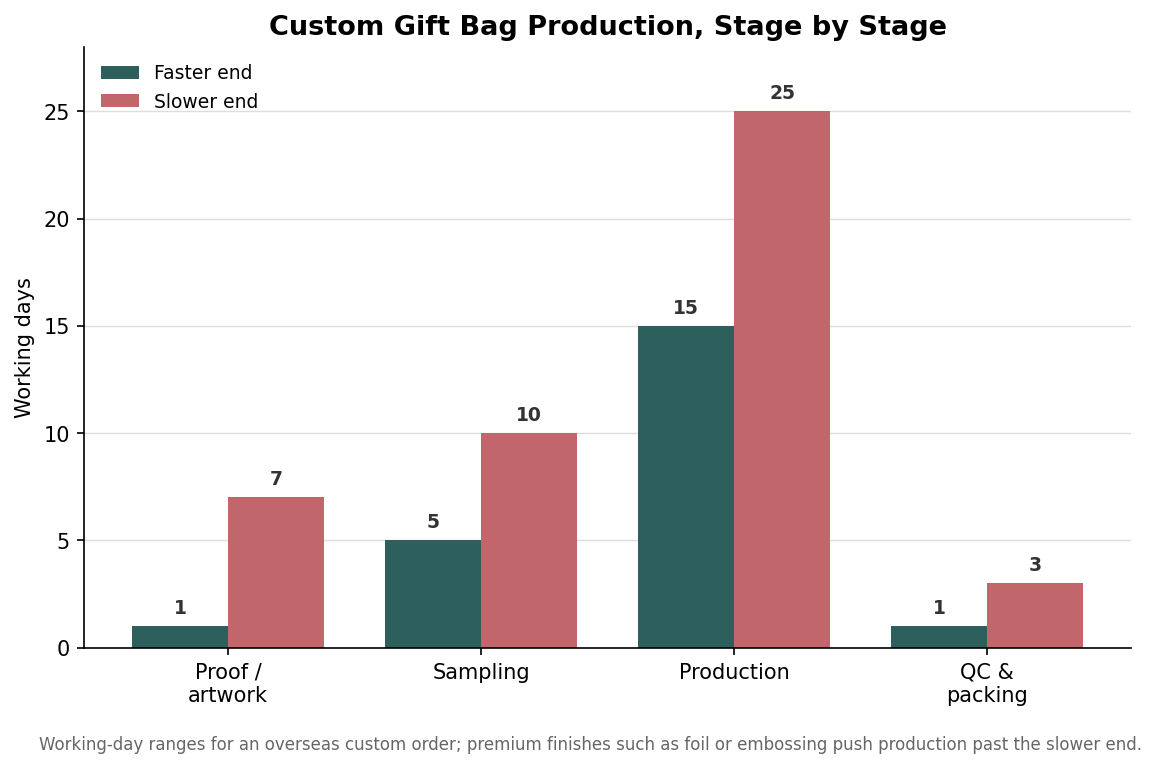
    Whatever the supplier or country, a custom gift bag order moves through the same four stages, and each one has a fairly stable duration. Proof and artwork comes first: if you supply print-ready files that meet the template, a digital proof can turn around in one to two days, but if the art needs rebuilding or the layout has to be redrawn to the die line, plan on three to seven days of back-and-forth before anyone approves anything. Sampling follows, where a physical pre-production sample is made to the approved specification; that typically runs five to ten working days, and every round of revisions adds another three to seven. Production is the long pole, usually fifteen to twenty-five working days once the sample and specs are locked, stretching past that when foil stamping, embossing, or special laminates are involved. Quality control and packing closes it out in one to three days.

    Grouped bar chart of custom gift bag production stages showing faster and slower end durations in working days
    Production is the long pole; proofing and packing are short, and premium finishes push production past the slower end.

    Those stage durations are working days, not calendar days, and they assume the order is not sitting in a queue behind other jobs. Add weekends, holidays, and the reality that suppliers batch work, and the honest planning number is always a little longer than the sum of the parts. It also helps to know which stage you are in at any moment, because the cost of a change rises sharply as you move down the list: a tweak during proofing is free, the same tweak after the sample is approved means a re-sample, and a change after production has started usually means starting over.

    Shipping is where domestic and overseas orders diverge

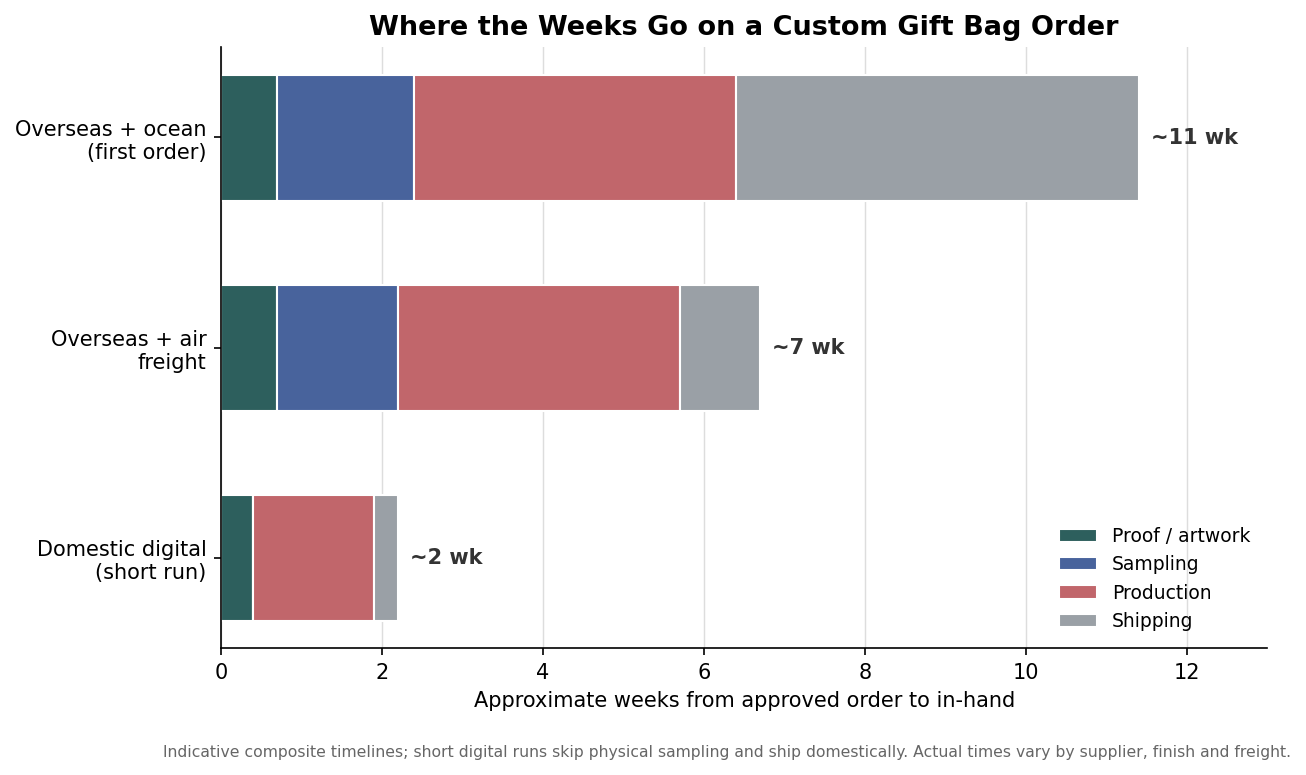
    Up to the point the bags leave the factory, a domestic and an overseas order look similar. Shipping is where they split apart. Express courier moves small quantities in one to five business days and air freight in roughly three to seven, but both are priced for urgency and rarely make sense for a full pallet of bags. Ocean freight is the default for bulk, and it is slow: port-to-port to the US West Coast runs about fifteen to twenty days and to the East Coast twenty-five to thirty-five, before you add customs clearance and the truck leg inland. That ocean window is why a bag that took four weeks to make can still be six weeks from arriving.

    Stacked bar chart comparing total custom gift bag timeline in weeks for domestic digital, overseas air, and overseas ocean sourcing paths
    Sourcing path drives the total: a domestic digital run can beat one to three weeks while an overseas ocean order approaches twelve.

    The practical takeaway is that sourcing path matters more than any single production detail. A short digitally printed run made and shipped domestically can be in your hands in one to three weeks because it skips physical sampling and ocean transit entirely. The same design produced overseas as a litho-laminated bag with a rope handle, sampled and shipped by sea on a first order, realistically wants ten to fourteen weeks, and a peak-season order competing for factory and vessel space can push to sixteen or more.

    Planning backward from the date you need them

    Because the stages are predictable, the smart move is to start from your in-hand date and subtract. If you need bags for a store opening or a holiday season, count back the full production-plus-shipping window, then add a buffer for the proofing and sampling that happens before the clock even starts. For a first overseas order that means committing your artwork roughly three months ahead, not three weeks. Holiday orders are the classic trap: fourth-quarter demand collides with factory backlogs and container shortages, so the same job that runs in ten weeks in spring can need fourteen in the fall. If your date is fixed and immovable, build in a week of slack for a failed sample or a revision, because a rejected proof quietly resets part of the timeline.

    How to compress the timeline safely

    You can shorten a schedule, but each lever has a cost or a risk. Supplying genuinely print-ready artwork that matches the die line is the cheapest week you will ever save, because it collapses the proof stage and reduces the chance of a re-sample. Approving a digital proof instead of waiting for a physical sample saves days, though it trades away your last chance to feel the paper and check the print before the full run. Paying a rush premium, often in the range of twenty to thirty percent, can pull perhaps five to ten days out of production, but it does nothing for ocean transit. And choosing a domestic digital run for smaller quantities is the most reliable way to buy speed outright, at a higher per-unit price than an overseas bulk run. The one lever you should not pull is skipping the sample on a complex bag, since a structural or color problem discovered after production is far more expensive than the time a sample would have cost.

    Once you have ordered a design you intend to reorder, keep a simple reordering rule in mind: place the next order when your remaining stock covers about three weeks plus your full lead time, so a slow production run or a delayed vessel never leaves you empty. Lead time is not the enemy on a custom gift bag order. Treating it as a surprise is.

  • Custom Gift Bags: 2026 Pricing, MOQs & Buying Guide

    Custom gift bags are one of the fastest ways to turn a plain purchase into a branded unboxing moment, but pricing swings wildly depending on where you order and how many you buy. A run of 100 premium shopping-style bags can cost nearly $1.50 apiece, while the same style at 1,000 units drops under a dollar — and some no-minimum print shops will sell you as few as 10 bags starting around $0.35 each. Before you commit a budget line to custom gift bags, it helps to know what the real numbers look like across quantity tiers, minimum order requirements, and turnaround windows.

    This guide pulls current pricing and minimum order data from several gift bag suppliers so you can see where your order actually lands on the cost curve, plus what to expect on lead times and material choices before you send art to print.

    Entry-level price
    $0.35/bag
    Lowest MOQ
    10 bags
    Standard lead time
    7-15 business days
    Price drop, 100 to 1,000 units
    ~36%

    Source: PackHit.com and Uprintly.com pricing pages; lead-time ranges from Westpack, 4AllPromos, EPACK Printing, and Crestline vendor pages, accessed August 2026

    What custom gift bags cost at different order quantities

    Price per bag is driven almost entirely by quantity, and the curve is steep at the low end. At Uprintly, a run of custom premium shopping-style bags prices out at $1.49 each for 100 units, $1.19 each for 300 units, $1.00 each for 500 units, and $0.96 each for 1,000 units — a drop of roughly a third in unit cost between the smallest and largest tier listed. That pattern holds across most vendors: the first real price break usually lands between 250 and 500 units, and after that the per-bag savings flatten out.

    At the value end of the market, no-minimum print shops like PackHit advertise custom gift bags starting around $0.35 per unit, though that figure applies to their simplest bag styles and print options rather than a premium laminated or rope-handle bag. Once you add features — foil stamping, ribbon handles, tissue paper, gusseted bottoms, or a heavier paper stock — expect the per-unit price to climb well past that entry-level number.

    If you’re pricing out a first order, run the numbers at two or three quantity tiers before you commit. Moving from 250 to 500 bags often costs less in total than buyers expect, because the per-unit rate drops enough to partly offset the extra units.

    Per-bag price falls from $1.49 to $0.96 as order size grows from 100 to 1,000 units.100 units: $1.49; 300 units: $1.19; 500 units: $1.00; 1,000 units: $0.96100 units$1.49300 units$1.19500 units$1.001,000 units$0.96
    Per-bag price falls from $1.49 to $0.96 as order size grows from 100 to 1,000 units.Source: Uprintly.com, Custom Premium Shopping Bags pricing page, accessed August 2026

    Minimum order quantities: how small can you go?

    Minimum order quantities vary more than most first-time buyers expect, and the gap matters if you’re ordering for a single event versus stocking a retail counter. Totally Promotional sets its bag minimums as low as 12 units on select styles, which works for a small wedding party or an internal team gift. PackHit goes further, allowing orders as small as 10 bags with no set minimum at all, and offers sizes ranging from 4 inches up to 18 inches so the same no-minimum policy covers everything from a jewelry-size bag to a full apparel bag. Uprintly, by contrast, sets its published pricing tiers starting at 100 units.

    The comparison below lines up starting price against minimum order size for three suppliers, so you can see the trade-off between ordering flexibility and unit cost.

    PackHit’s no-minimum model undercuts standard 100-unit suppliers by roughly $1 per bag at entry-level order sizes.
    Supplier Starting price Minimum order Size range
    PackHit $0.35/bag 10 bags (no set minimum) 4″ to 18″
    Totally Promotional ~$1.00/bag 12 bags (select styles) Varies by style
    Uprintly $1.49/bag at 100 units 100 units Varies by style
    PackHit’s no-minimum model undercuts standard 100-unit suppliers by roughly $1 per bag at entry-level order sizes.Source: PackHit.com, TotallyPromotional.com, and Uprintly.com vendor pricing pages, accessed August 2026

    Lead times: how long custom printing actually takes

    Standard production time for custom gift bags runs 7 to 15 business days after you approve your art proof, based on published timelines from suppliers including Westpack, 4AllPromos, EPACK Printing, and Crestline. Simple one- or two-color imprints on stock bag shapes tend to sit at the fast end of that range, often shipping within about a week of proof approval. Bags that require custom die lines, multiple ink colors, foil stamping, or a non-stock size push closer to the 12-to-15-business-day mark, since those steps add plate-making or tooling time before the print run even starts.

    None of those windows include shipping. Build transit time on top of production, and add a buffer if your event date is fixed — a proof revision cycle alone can eat two or three days if your first design doesn’t come back clean. Most suppliers offer a rush option for an added fee if you’re working against a hard deadline, but rush pricing isn’t standardized across vendors, so ask for a quote rather than assuming a flat surcharge.

    Picking the right material and size

    Kraft paper is the default starting material for custom gift bags because it’s the cheapest substrate to print on and it takes ink, foil, and hand-applied ribbon handles well. It’s also a forgiving choice if you’re not sure yet how the bag will be used — kraft reads as equally at home in a boutique, a trade show booth, or a wedding favor table. Laminated and coated paper stocks step up from there, adding water resistance and a glossier finish that reads as more premium on shelf, but they also add cost and typically push production time slightly longer because of the extra coating step.

    Size matters more than most buyers plan for upfront. A bag sized for a candle or a bar of soap doesn’t need the same gusset depth as one meant to hold a folded garment, and ordering a size that’s slightly too small is a common reason buyers end up reordering. If your product mix varies, it’s usually cheaper to standardize on one or two bag sizes across your catalog than to order a custom size for every SKU — each additional custom die run carries its own tooling cost.

    Printing methods and what they add to the price

    The imprint method you choose changes both price and lead time. Flat digital or offset printing directly onto the bag is the cheapest and fastest option, and it’s the default at most of the vendors referenced in this guide. Foil stamping — pressing a metallic or matte foil logo into the paper — costs more per unit and typically adds tooling time up front because it requires a custom die, but it’s the method most often associated with a premium, retail-shelf look. Screen printing sits in between: it handles bold, simple logos well and holds up to handling, but it isn’t well suited to fine detail or full-color photography.

    If your logo is one or two colors, screen printing or a simple digital imprint will keep your per-unit cost near the lower end of the pricing tiers above. If you’re set on a metallic finish or a multi-color photographic design, budget for both a higher per-bag price and a longer first-run lead time to account for die-making.

    Mistakes that blow up your gift bag budget

    The most expensive mistake is ordering too few bags to hit the next price break, then reordering weeks later at a worse rate plus a second setup fee. Since the steepest discount usually lands between 250 and 500 units, it’s worth checking whether a slightly larger order — even one you don’t fully use this quarter — actually costs less than two smaller runs.

    The second most common mistake is skipping the proof stage or rushing through it. A design that looks right on screen can print with handle placement, color, or logo scale that reads differently on the finished bag, and once a full run is printed, there’s no fixing it without reordering. Ask for a physical sample or a production-run photo before the full batch ships, especially on a first order with a new supplier.

    Finally, don’t assume every quoted price includes handles, tissue paper, or assembly. Rope or ribbon handles are sometimes priced as an add-on rather than folded into the base per-bag rate, and that gap can move your real cost more than the headline price suggests.

    Frequently asked questions

    What’s the minimum order for custom gift bags?

    It depends on the supplier. PackHit allows orders as small as 10 bags with no set minimum, Totally Promotional sets minimums around 12 units on select styles, and other suppliers like Uprintly publish pricing starting at 100 units.

    How much do custom gift bags cost per unit?

    Entry-level pricing starts around $0.35 per bag at no-minimum suppliers for basic styles. A premium shopping-bag style runs about $1.49 per bag at 100 units and drops to roughly $0.96 per bag at 1,000 units, based on Uprintly’s published pricing tiers.

    How long does it take to get custom printed gift bags?

    Standard production is 7 to 15 business days after you approve an art proof, not counting shipping. Simple one- or two-color imprints ship faster; foil stamping or custom sizes push toward the longer end. Rush service is available from most suppliers for an added fee.

    What material should I choose for custom gift bags?

    Kraft paper is the standard, cost-effective choice and takes printing, foil, and ribbon handles well. Laminated or coated paper stock costs more and adds production time but offers better water resistance and a glossier finish.

    Does the quoted price include handles?

    Not always. Ribbon or rope handles, tissue paper, and assembly are sometimes priced as add-ons rather than included in the base per-bag rate, so confirm what’s bundled before comparing quotes across suppliers.

    The bottom line

    Custom gift bags are inexpensive enough that most of the real decision is about fit, not affordability — the right size, the right material, and an order quantity that lands past the first price break. Use the pricing tiers and minimum-order comparison above as a starting point, then get a firm quote from your chosen vendor before you lock in art, since foil, ribbon handles, and rush service all move the final number.

  • Why Gift Bags Fail: A Guide to Paper Weight, Handles, and Load

    Why Gift Bags Fail: A Guide to Paper Weight, Handles, and Load

    A gift bag has exactly one structural job: to survive being filled, lifted, and carried without giving out. When one fails, it almost always fails in the same few places — a handle pulls free, the base splits, or the top edge tears where fingers dug in. None of that is bad luck. It is the predictable result of a paper weight, a handle style, or a base construction that was under-specified for the load. This guide walks through where the strength actually comes from, so you can order a bag that matches what you plan to put in it rather than discovering the mismatch at the counter.

    Start with paper weight

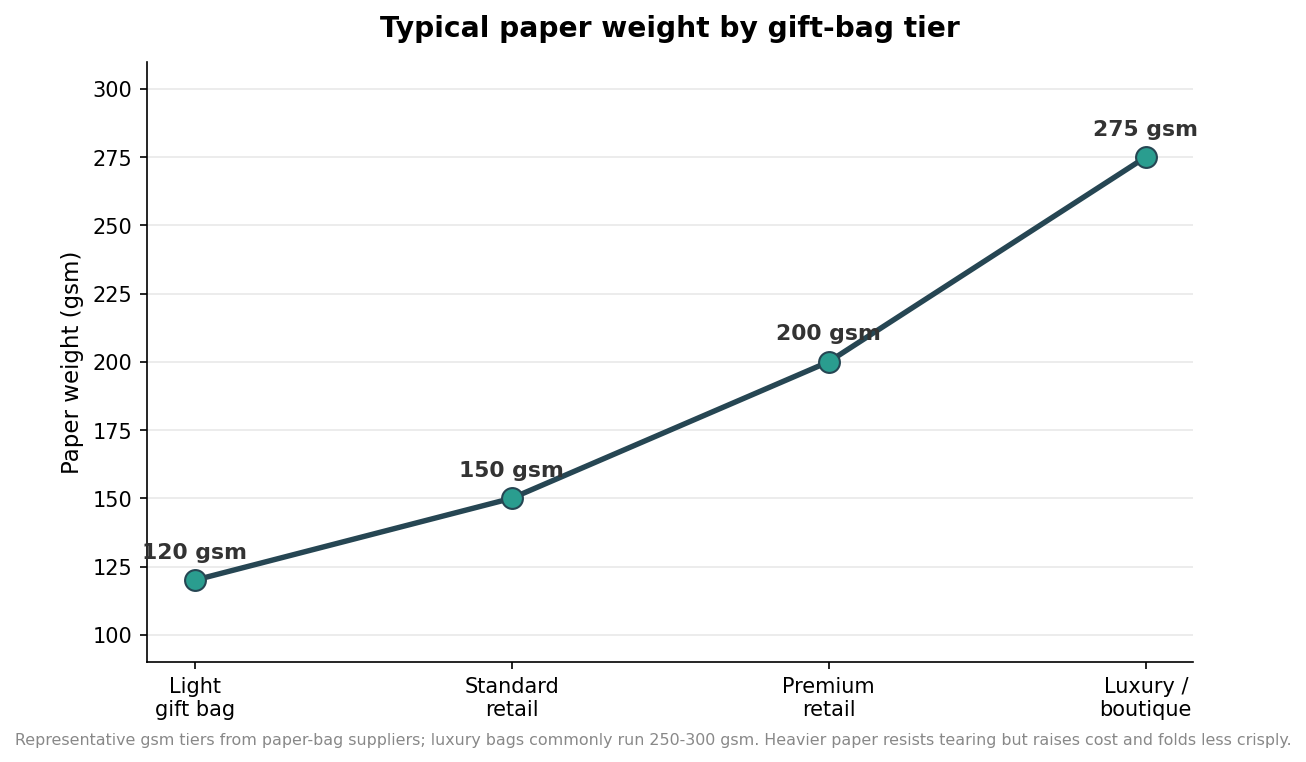
    Paper weight, measured in grams per square meter, is the foundation every other strength decision sits on. As a rough map of the market, lightweight gift bags run around 120 gsm and suit small, light contents; standard retail bags sit near 150 gsm; premium retail bags step up to about 200 gsm; and luxury or boutique bags commonly land in the 250 to 300 gsm range, where the paper feels almost board-like and holds a crisp fold. Heavier paper resists tearing and keeps its shape when a bag is only partly full, which is part of why upscale brands pay for it. The trade-offs are real, though: heavier stock costs more per bag, folds less cleanly on tight gussets, and adds shipping weight across a large order. The goal is not the heaviest paper available but the lightest weight that comfortably carries your contents. Paper type matters alongside weight, too: virgin kraft is generally stronger and tears less readily than the same weight in recycled stock, so a sustainability choice can quietly cost you some strength unless you step the gsm up to compensate.

    Line chart of typical paper weight by gift bag tier: light 120 gsm, standard 150 gsm, premium 200 gsm, luxury 275 gsm
    Paper weight climbs from light gift bags to luxury boutique bags; match the weight to the contents, not to the top of the range.

    Handles carry the load, and they fail first

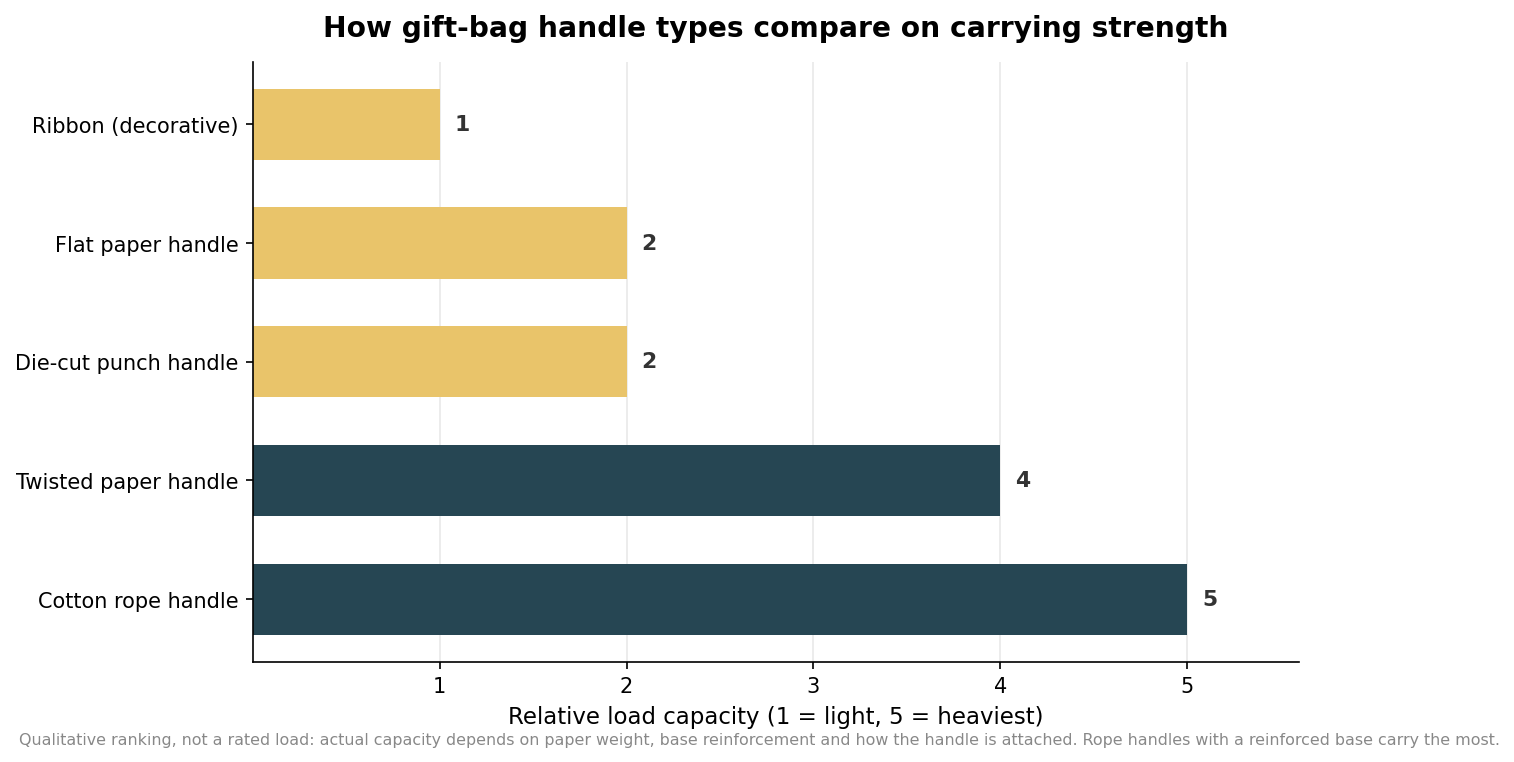
    The handle is the single most common failure point, because it concentrates the entire weight of the bag onto two small attachment areas. Ribbon handles are essentially decorative and belong on light, pretty packages. Flat paper and die-cut punch handles handle modest weights and keep costs and thickness down, which is why they dominate low-cost retail. Twisted paper handles are the workhorse of general retail: machine-applied, comfortable to hold, and good for everyday loads. Cotton rope handles sit at the top for strength and for perceived value, which is why they define the luxury boutique bag — but only when they are anchored properly. How a handle is attached matters as much as its type: a rope handle knotted through the wall with a reinforcing patch behind it will outlast one simply glued to the inside face. Ask how handles are fixed, not just what they are made of. It also helps to load a bag so the weight sits low and centered rather than swinging from one side, since an off-center load puts most of the strain on a single handle anchor.

    Horizontal bar chart ranking gift bag handle types by relative load capacity, with cotton rope strongest and ribbon weakest
    Handles are the first thing to fail; rope handles carry the most, but only when anchored with a reinforcing patch.

    The base and the top edge do the quiet work

    Two unglamorous features quietly decide whether a bag survives a heavy load. The first is the base. A plain folded bottom will bow and eventually split under weight, so bags built for anything substantial include a base insert — a stiff card dropped into the bottom that spreads the load and keeps the footprint square. The second is the top edge. A raw cut edge is where tears start; a turned-over hem, where the paper is folded back on itself and glued along the opening, roughly doubles the paper at the most-handled line and resists the finger-tearing that kills lesser bags. Glued side and bottom seams are the third quiet factor, and a wide, well-bonded seam is far less likely to peel than a narrow one. When you compare quotes, these construction details — base insert, turned top edge, seam width — explain most of the price gap between two bags that look identical flat.

    Lamination changes durability, not just looks

    A film lamination is usually sold as a finish, but it is also a structural and protective upgrade. A matte or gloss laminate adds a measure of tear and scuff resistance and, importantly, a degree of moisture resistance — useful if bags may sit in a damp entryway, travel in the rain, or hold anything that can sweat or weep. The trade-off is that laminated bags are harder to recycle and slower to break down than an uncoated kraft bag, so if a recycled or compostable story matters to your brand, weigh that against the durability gain. For many buyers the honest answer is to laminate only the lines that need it and leave everyday bags uncoated.

    Match the bag to what goes in it

    Strength is only ever relative to the contents, so specify from the load backward. Small, dense, heavy items — a stack of candles, a bottle, hardware — punish handles and bases, so they call for heavier paper, a base insert, and rope or well-anchored twisted handles. Large but light contents — apparel, soft goods — are forgiving on weight but need enough bag size and stiffness that they don’t slump. Sharp or cornered items want a rigid bag or interior protection so a corner doesn’t punch through the wall. And anything damp, greasy, or refrigerated points toward a laminate or a poly-lined option. Decide the heaviest, most awkward thing the bag will ever carry, spec for that, and the everyday cases take care of themselves. A bag that costs a few cents more but never fails in a customer’s hand is the cheaper bag in the end.

  • How Custom Gift Bags Are Printed: Choosing the Right Process for Your Run

    How Custom Gift Bags Are Printed: Choosing the Right Process for Your Run

    Most people start a custom gift bag order from the artwork and work outward. The printer starts from a different place: how many bags you need and what the design demands. Those two questions decide which printing process makes sense, and the process in turn shapes your cost, your minimum order, and how faithfully your logo lands on the bag. If you understand the four common methods before you request a quote, you can specify a bag that looks right and prices right instead of paying premium-process money for a job a cheaper method would have nailed.

    Start with the run size, not the logo

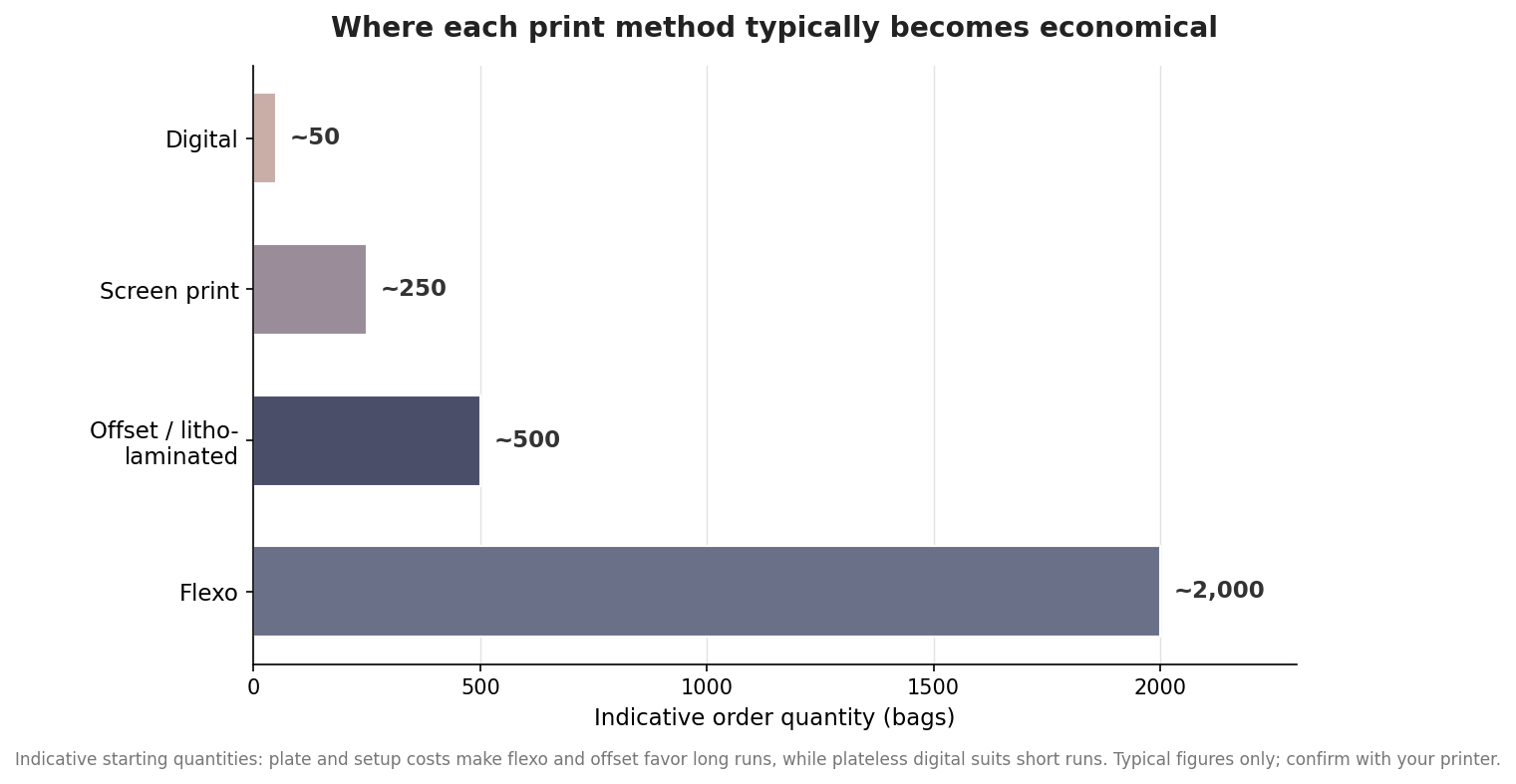
    Every printing method carries a fixed setup cost and a per-bag cost, and the balance between them is what decides the economical choice. Methods that need a physical plate or die spread that setup over the run, so they only get cheap once the quantity is large. Plateless methods skip the setup but cost more per unit, which makes them the sensible pick for short runs. Before comparing looks, place your order on that spectrum, because a beautiful process at the wrong volume is simply an expensive one.

    Horizontal bar chart of the indicative order quantity where each print method becomes economical: about 50 for digital, 250 for screen, 500 for offset, and 2,000 for flexo
    Roughly where each method turns economical; setup cost pushes flexo and offset toward long runs.

    The four ways a bag gets printed

    Flexography, or flexo, presses ink from a flexible raised plate directly onto the paper, usually the unbleached kraft used for grocery-style and everyday retail bags. It is fast and, at high volume, the cheapest option per bag. The trade-off is detail: flexo handles bold logos and a few solid spot colors well, but it struggles with fine lines, small text, soft gradients, and photographic images. It is the right call when you are ordering thousands of bags with a clean, simple mark.

    Offset, most often delivered as litho-lamination, prints your art with high fidelity onto a sheet that is then laminated to the bag. This is the process behind glossy, full-color boutique and gift bags, because it reproduces small text, fine lines, gradients, and full-color artwork cleanly. The catch is setup: plates and lamination raise both the cost and the lead time, so offset rewards larger premium runs rather than a quick fifty-bag job.

    Digital printing uses no plate at all, so there is little setup cost and turnaround is quick. That makes it the natural fit for short runs, test batches, and jobs with changing artwork, and it now handles full color respectably. Its weakness is scale: because the per-bag cost barely drops with volume, digital loses to flexo and offset once you are into the thousands.

    Screen printing pushes ink through a mesh stencil and lays down thick, vivid spot color, which looks especially good as a one- or two-color logo on a natural kraft bag. It sits in the middle on setup and does not reproduce gradients or photographs, so it suits bold, limited-color branding on small to medium runs rather than detailed imagery.

    Finishes are a separate decision

    Foil stamping and embossing are not printing methods; they are finishing steps applied on top of, or instead of, printing, and they each need their own tooling. Foil stamping presses metallic foil from a heated die and is built for logos and short brand names rather than full images, with a minimum line thickness so fine details do not drop out. Embossing uses a matched pair of molds to press a raised, tactile shape into the paper, which reads as premium but needs a thicker stock to hold the impression and does not carry complex detail. Both add cost and production time, and both push you toward heavier paper, which is why the finish you want and the paper weight you choose are really one decision.

    Choosing the paper weight

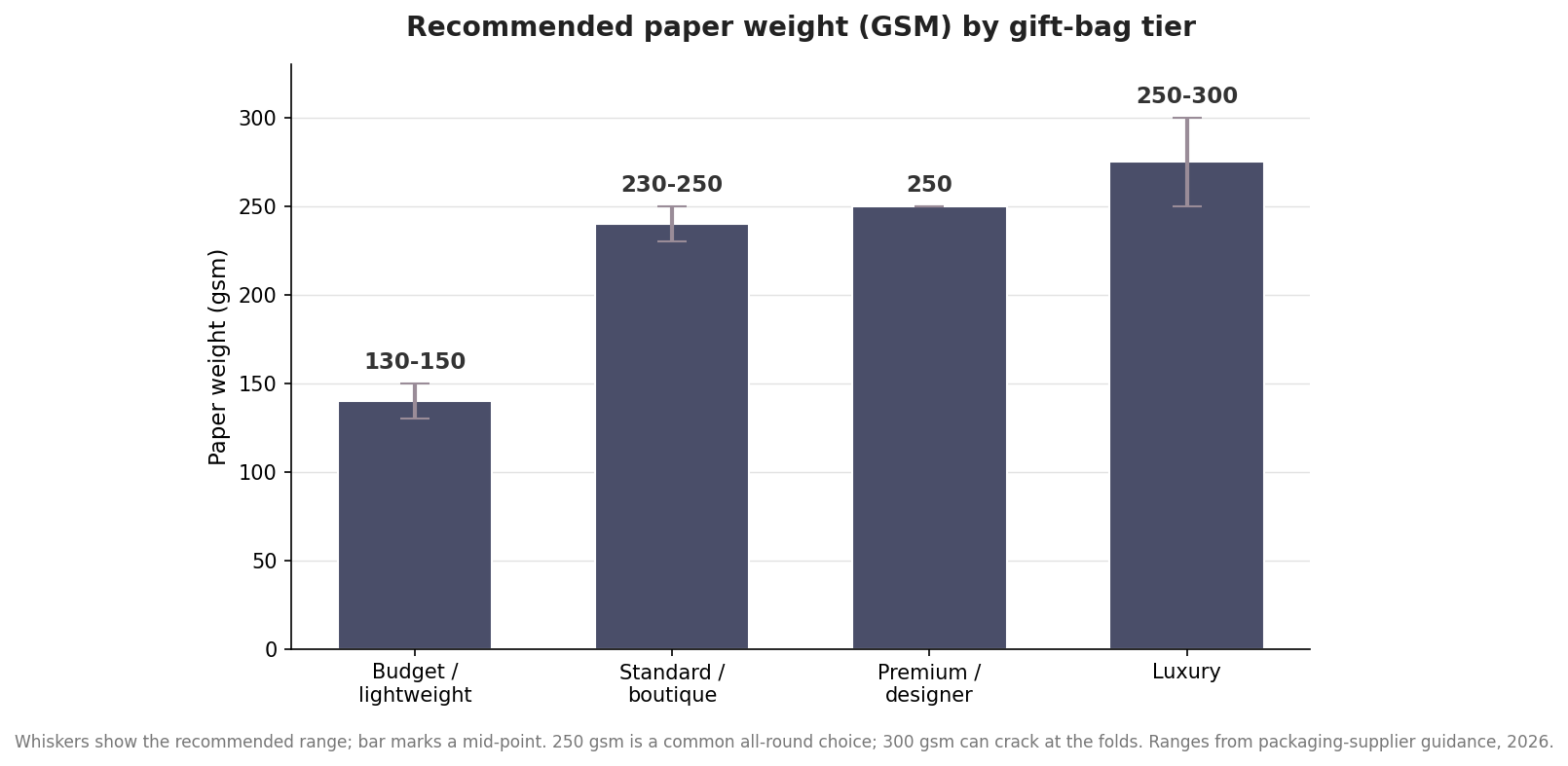
    Paper weight is measured in grams per square meter, or gsm, and it governs how sturdy the bag feels and how much it can carry. Lighter kraft bags around 130 to 150 gsm are the cost-efficient choice for light contents such as folded apparel, but they are not built for heavy items or for decorative finishing. Standard retail and boutique bags typically move up to the 230 to 250 gsm range, where the bag feels substantial and can take basic foil work. Around 250 gsm is the common all-round sweet spot: it offers strong load capacity, handles heavier or multiple items, and works with virtually any finish. Luxury bags run from 250 up toward 300 gsm on white or specialty stock for the richest hand.

    Bar chart of recommended paper weight in gsm by gift-bag tier: 130-150 budget, 230-250 boutique, about 250 premium, and 250-300 luxury
    Recommended paper weight by tier; around 250 gsm is the common all-round choice.

    It is tempting to assume heavier is always better, but that is where buyers overspend. Pushing to 300 gsm buys little real strength over 250 and introduces a practical problem: the very stiff board is prone to cracking along the fold lines during manufacturing, which can leave visible white lines on a dark printed bag. Unless you specifically need the heft of a flagship-store bag, 250 gsm is usually the smarter ceiling.

    Putting the spec together

    Work in order. First, fix the quantity and let it point you toward a process: a short, colorful run leans digital, a bold-logo kraft run in the thousands leans flexo, a limited-color logo on kraft suits screen, and a large full-color premium run calls for offset litho-lamination. Second, decide whether the design truly needs photographic detail or gradients, since that requirement alone can rule out flexo and screen regardless of quantity. Third, choose the paper weight from the contents and the finish, defaulting to around 250 gsm unless the bag will carry very light or unusually heavy loads. Bring those three answers to your printer instead of only a logo file, and the quote you get back will match the bag you actually pictured, at a price that reflects the job rather than the fanciest process on the menu.

  • How to Choose Custom Gift Bags for Your Brand

    How to Choose Custom Gift Bags for Your Brand

    How to Choose Custom Gift Bags for Your Brand: Use Cases and Ordering

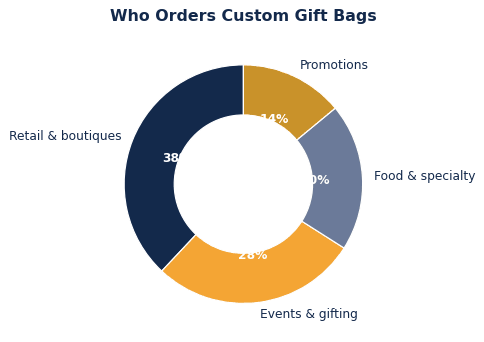
    The best way to choose custom gift bags is to start from how they will be used, then work back to the material, size, and decoration that fit. Custom gift bags serve very different jobs across retail & boutiques, events & gifting, food & specialty, and promotions, and matching the order to the job is what makes custom gift bags feel purpose-built rather than generic. This guide maps the common use cases and walks through ordering custom gift bags that fit your brand.

    Whether the gift bags protects a product, presents a gift, or carries a logo into the world, defining that job first keeps every later decision easy. Purpose drives the spec, and the spec drives the result.

    How brands use custom gift bags

    Custom gift bags get ordered for a mix of protection, presentation, and promotion, and knowing where yours fall points you to the right build. The breakdown below shows the common uses, from retail & boutiques to promotions.

    The common ways brands put custom gift bags to work.
    The common ways brands put custom gift bags to work.

    Most orders lean toward one primary job with a secondary benefit — a shipping-focused gift bags that also brands the unboxing, or a gift-focused one that also protects. Naming your primary use keeps the order focused and the spec appropriate.

    Use case What it needs
    Retail & boutiques branded carry-out that markets the store
    Events & gifting take-home bags guests keep and reuse
    Food & specialty product-appropriate bags sized to the item
    Promotions reusable bags that keep a logo in circulation

    Matching material and size to the use

    Once the use is clear, the material and size follow. A protection-first job favors a durable, well-fitted build; a presentation-first job favors a premium material and a clean print; a promotion-first job favors a cost-effective option you can order in volume. Sizing to the product with a small margin keeps the gift bags looking intentional and performing its job.

    If a single order serves more than one use, spec to the most demanding one so the gift bags performs everywhere. It is easier to use a slightly sturdier or more premium gift bags across the board than to discover a bargain option falls short for your most important use case.

    Branding for the impression you want

    Decoration should reinforce the impression the use calls for. Screen printing suits bold one- or two-color logos, while full-color printing wraps detailed art edge to edge. For a premium or gift use, lean on finishes and restraint; for high-volume promotion, prioritize a bold, legible logo that reads at a glance and reproduces affordably at scale. Keep branding consistent with the rest of your packaging or merch so everything reads as one system.

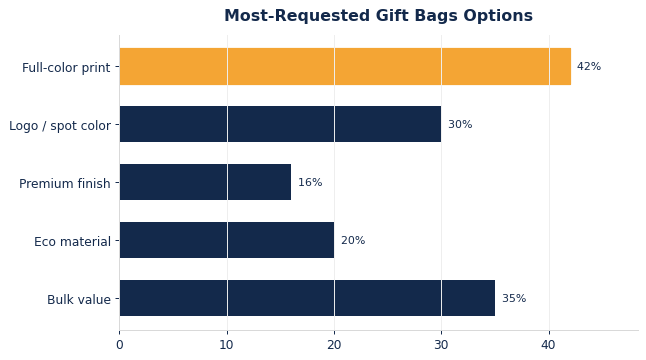
    The most-requested options below reflect what buyers reach for most, and they are a useful starting menu when you brief your order. Whatever you choose, approve a proof so the finished custom gift bags match the impression you intended.

    The options buyers request most on custom gift bags.
    The options buyers request most on custom gift bags.

    Getting the size and details right

    Even with the use and material decided, the details are what make custom gift bags feel finished. Confirm the size and gusset against the product with a small margin, check the print area for your chosen size so the logo sits cleanly, and decide on any finishing touches before you brief the order. These small confirmations up front are what separate a gift bags that looks intentional from one that looks close-enough.

    A sample or proof is the cheapest insurance you can buy on a gift bags order. A physical sample lets you judge the material and print in hand, while a digital proof confirms artwork, color, and size and gusset before the full run. Spending a few minutes here prevents the far larger cost of reworking a finished order of custom gift bags that missed on a detail.

    Ordering: quantities, lead time, and reorders

    A smooth gift bags order comes down to a few basics: order for real demand plus a small overage, send print-ready artwork early, and confirm lead time against any deadline so production and shipping fit your timeline. Per-unit cost drops with volume, so consolidating a season’s needs into one run is usually more efficient than repeated small orders.

    Keep your approved artwork and spec on file so reorders are a quick repeat rather than a fresh setup each time — consistency across runs keeps your brand looking deliberate.

    Coordinating with the rest of your brand

    Custom gift bags rarely stand alone; they sit alongside your other packaging, print, or merch, so coordinating them strengthens the whole brand. Carrying the same logo, colors, and tone across your gift bags and your other pieces makes everything read as one deliberate system rather than a set of one-off orders. That consistency is what makes a brand feel established, and it costs nothing extra to plan.

    Coordination also simplifies buying over time. Standardizing on a material, size, and decoration you are happy with turns future orders into simple repeats, and it keeps every batch matching the last. A little upfront alignment pays back every time you reorder custom gift bags.

    Frequently asked questions about custom gift bags

    What are custom gift bags used for?

    Custom gift bags serve a mix of protection, presentation, and promotion across retail & boutiques, events & gifting, food & specialty, and promotions. Most orders lean toward one primary job with a secondary benefit, so naming your main use is the first step in speccing the right gift bags.

    How do I match custom gift bags to my use?

    Let the use drive the spec: durable and well-fitted for protection, premium and clean for presentation, cost-effective and bold for promotion. If one order serves several uses, spec to the most demanding one so the gift bags performs everywhere.

    How should I brand custom gift bags?

    Screen printing suits bold one- or two-color logos, while full-color printing wraps detailed art edge to edge. Choose finishes and restraint for premium or gift uses, and a bold, legible logo for high-volume promotion, keeping the branding consistent with your other packaging or merch so it all reads as one system.

    How far ahead should I order custom gift bags?

    Order for real demand plus a small overage, send print-ready artwork early, and confirm lead time against any deadline so production and shipping fit your timeline. Consolidating a season’s needs into one run is usually more efficient than repeated small orders.

    Can I reorder easily?

    Yes. Keeping your approved artwork and spec on file makes reorders a quick repeat rather than a fresh setup, and it keeps every batch of custom gift bags matching the last for a consistent brand look.

    Do I need a sample before ordering custom gift bags?

    A sample is worth it for a first order or a new material, since judging feel and print in hand removes the guesswork. For a straightforward reorder of custom gift bags you have bought before, a digital proof confirming artwork and size and gusset is usually enough.

    Match the gift bags to the job, spec it deliberately, and approve a proof, and your order will do exactly what you needed. For the full material and sizing breakdown, see our companion guide, our Custom Gift Bags: Materials, Sizing & Branding Guide, and browse our our shop to get started.

    Not sure which custom gift bags fit your use?

    Tell us how you’ll use them and we’ll match the material, size, and branding to the job.

    Get a Quote

  • Custom Gift Bags: Materials, Sizing & Branding Guide

    Custom Gift Bags: Materials, Sizing & Branding Guide

    Custom Gift Bags: A Materials, Sizing, and Branding Guide

    Getting custom gift bags right comes down to three decisions: the material, the size or spec, and how you brand them. Make those well and you end up with custom gift bags that protect and present your product, reinforce your brand, and land on budget. This guide walks through the material options, how to size and spec your order, and how to decorate custom gift bags so they do real work for your brand rather than just checking a box.

    Whether you are ordering your first run or reordering at scale, the same fundamentals apply. Choosing custom gift bags deliberately — material to job, size to product, decoration to brand — is what separates an order you are proud of from one you settle for.

    Why custom gift bags matter for your brand

    Custom gift bags are more than a commodity; they are a touchpoint brands experience directly. A well-chosen, well-branded option signals quality and attention to detail, while a generic one quietly undercuts an otherwise strong product. Because custom gift bags are seen and handled, they carry your brand into the world every time they are used.

    That visibility is exactly why it pays to spec custom gift bags intentionally. The material sets the feel, the size sets the fit and cost, and the decoration sets the impression — and getting all three aligned turns a functional item into a genuine brand asset.

    Materials and options compared

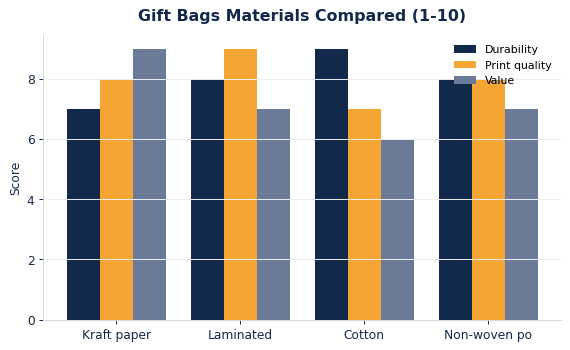
    The common materials for custom gift bags each trade off durability, print quality, and cost: kraft paper, laminated / matte film, cotton / canvas, and non-woven polypropylene. The right pick depends on how the gift bags will be used, the look you want, and your budget. The chart and table below compare the main options so you can match material to job.

    How common gift bags materials compare on durability, print quality, and value.
    How common gift bags materials compare on durability, print quality, and value.

    As a rule of thumb, choose a recyclable or natural material when eco positioning matters, a coated or laminated option when you want vivid full-color print, and a premium build when the gift bags is part of a gift or high-end presentation. When in doubt, request a sample so you can judge feel and print before committing to a full run.

    Material / option Best for
    Kraft paper recyclable and natural, ideal for eco positioning
    Laminated / matte film durable, moisture-resistant, premium finish
    Cotton / canvas reusable and sturdy for a keepsake feel
    Non-woven polypropylene low-cost, reusable, lightweight

    Sizing and specs

    Sizing is where many gift bags orders go wrong, so measure before you order. Custom gift bags typically range from a slim gift bag up to a wide gusseted grocery or retail bag, and the right size and gusset depends on the product or use they serve. Too small and the fit is tight or the product is exposed; too large and you pay for material you do not need and lose a clean, intentional look.

    When a measurement falls between standard options, size to the product with a small margin rather than guessing. Confirming the size and gusset on a proof or sample before a large run prevents the costly mistake of a full order that does not fit, which is far more expensive to fix than a five-minute check up front.

    Branding and decoration

    Decoration is what turns a plain gift bags into a branded one. Screen printing suits bold one- or two-color logos, while full-color printing wraps detailed art edge to edge. Match the method to your artwork and budget: simple logos reproduce cleanly and cheaply, while detailed, full-color designs shine with the right process on the right material. Keep the artwork vector where possible and confirm the print area for your chosen size.

    Restraint usually reads as premium. A clean logo, one or two brand colors, and quality material almost always look more considered than a busy, over-printed design. Approving a proof before the run protects both the look and the budget, especially on a large order of custom gift bags.

    Ordering and budget

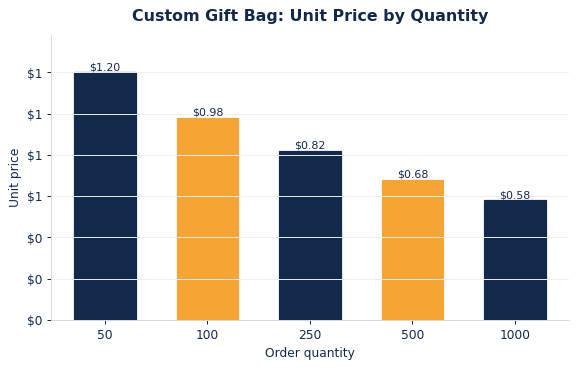
    Per-unit cost on custom gift bags falls steadily with volume as setup amortizes across more pieces, so ordering for real demand rather than a token first batch is usually the efficient move. The curve below shows how pricing typically improves with quantity, which helps you plan an order that balances cash and cost.

    Typical per-unit gift bags pricing as order quantity increases.
    Typical per-unit gift bags pricing as order quantity increases.
    Ordering for a recurring need? A single larger run lowers the unit cost and keeps your branding consistent, while a small overage covers reorders and the occasional damaged piece without a rush order.

    Common mistakes to avoid

    A few avoidable missteps account for most disappointing gift bags orders. Ordering before measuring is the biggest, followed by choosing a material for price alone without considering how the gift bags will actually be used, and skipping the proof on a large run. Each is easy to prevent with a few minutes of planning, and each is expensive to fix once a full order is produced.

    The other common trap is over-designing the artwork. Cramming in too many colors, effects, or details can muddy the print and raise the cost, especially on textured or recycled materials. Simplifying the design to a clean, legible mark almost always improves both the look and the price of your custom gift bags.

    Frequently asked questions about custom gift bags

    What material is best for custom gift bags?

    It depends on the use: choose a recyclable or natural material for eco positioning, a coated or laminated option for vivid full-color print, and a premium build for gifting or high-end presentation. Request a sample to judge feel and print before a full run of custom gift bags.

    How do I choose the right size?

    Measure the product or use the gift bags serves, then size to it with a small margin so the fit is clean without wasting material. When a measurement falls between standard options, size up slightly and confirm the size and gusset on a proof before ordering in volume.

    How are custom gift bags branded?

    Screen printing suits bold one- or two-color logos, while full-color printing wraps detailed art edge to edge. Match the method to your artwork and budget, keep the art vector where possible, confirm the print area for your size, and approve a proof so the finished custom gift bags match your intent.

    How does pricing work, and is there a minimum?

    Per-unit cost drops with quantity as setup amortizes across the run, so larger orders are more cost-effective. Order for real demand plus a small overage rather than a token batch, and consolidate recurring needs into one run for the best price.

    Can I get a sample or proof before ordering?

    Yes, and it is strongly recommended. A physical sample lets you judge material and print, and a digital or physical proof confirms your artwork, color, and size and gusset before a full run — a small step that prevents a costly mistake on a large order.

    What do you need to quote custom gift bags?

    To quote accurately we need the size and gusset or the product they serve, the quantity, your material preference, and your artwork or a description of the branding. With those details we can recommend the right material and size and give you pricing for the run, and a proof follows once the order is confirmed.

    Whatever you order, send vector artwork, confirm material and size and gusset, and approve a proof before production. For help matching custom gift bags to a specific use, see our companion guide, our How to Choose Custom Gift Bags for Your Brand, and explore our our shop to start your order.

    Ready to order custom gift bags?

    Tell us your product, quantity, and branding and we’ll match the material, size, and decoration for you.

    Get a Quote