Most buyers choosing custom gift bags start with size and color and treat the bag’s construction as an afterthought. That is backwards. A bag’s build, the way its body, bottom, and handles are engineered, determines whether it looks like a boutique purchase or a giveaway, how much it can carry without tearing, and what it costs per unit before you print a single logo. Four construction styles cover the overwhelming majority of retail and event gift bags, and they are genuinely different products. Knowing how they differ lets you spend your budget where it shows and avoid paying tote prices for a job a simpler bag would do better.
Four ways a gift bag is built
The euro tote is the premium standard. It is made from a sheet of laminated art paper folded with a turned-over top hem for a clean rigid edge, stiffened with a cardboard bottom insert, and finished with rope or cotton-cord handles set through eyelets. That construction is what gives a euro tote its structured, holds-its-shape look on a shelf, and it is why it photographs like a luxury bag. The SOS bag, short for self-opening square, is the flat-bottomed grocery-style sack that stands up on its own. Usually kraft, with twisted or flat paper handles glued inside the top, it is built for sturdiness at a working price rather than for polish. The die-cut handle bag punches the handle directly into the top of the bag, backed by a reinforcing patch, which removes the cost of a separate handle and makes it a popular economical choice for events and trade shows. The flat merchandise bag is the simplest of all: a thin, often handleless sleeve for apparel, cards, and small goods handed across a counter. Each of these is a different answer to the same question, and the chart below shows the first place they diverge.
What each style can actually carry
Load capacity is where assumptions get expensive. Many buyers assume the euro tote, being the most premium, is also the strongest, and that is often not true. A euro tote’s weak point is its handle attachment: rope handles set in eyelets will pull out of an underbuilt bag before the paper itself fails, which caps practical load. A well-made kraft SOS bag with integrated twisted handles frequently carries more weight than a euro tote of the same footprint because the handle is bonded into the bag body across a wide glue area. The figures below are indicative ranges, not guarantees, because real capacity swings widely with paper weight, bag size, and handle quality.
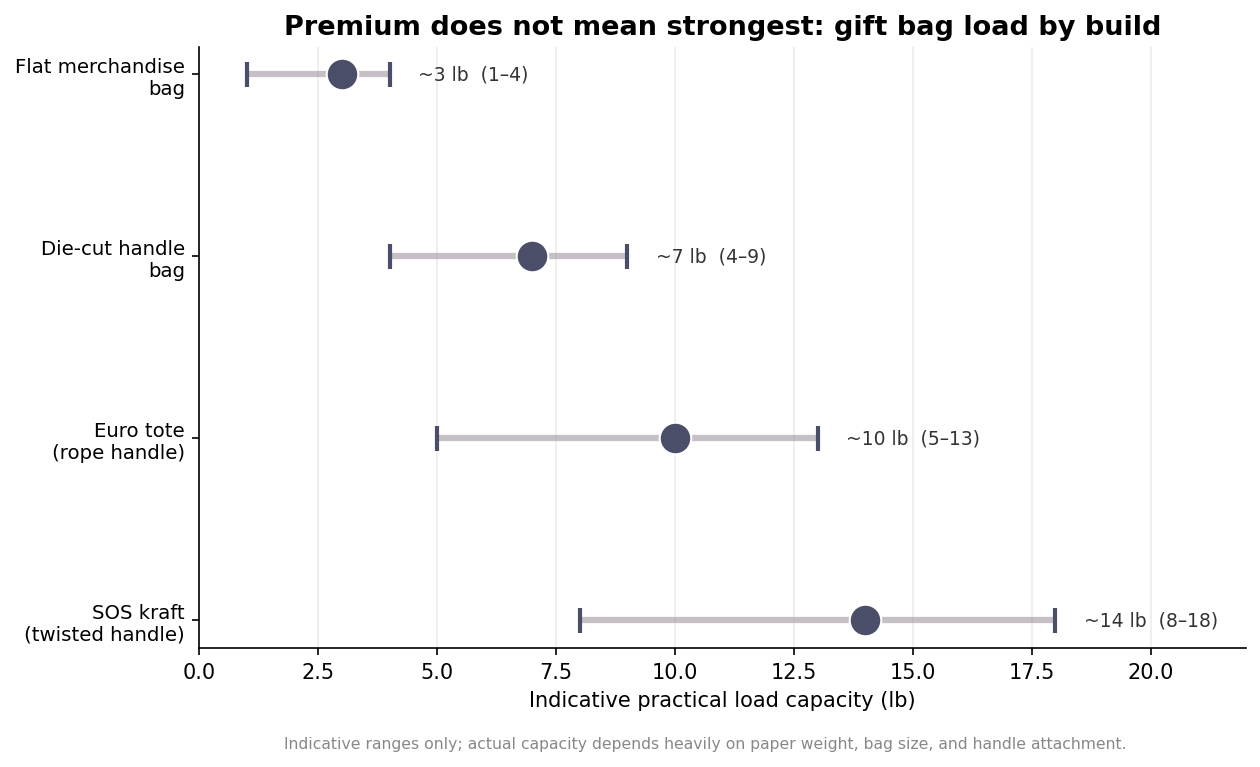
Read these as relative tendencies. A flat merchandise bag is a light-duty carrier and will split if you load it like a shopper; a die-cut handle bag handles moderate weight but concentrates stress at the punched hole, so it suits lighter, bulkier gifts rather than dense ones. If your product is genuinely heavy, specify a higher paper weight and a bonded handle regardless of which style you choose, and ask the supplier for a rated capacity in writing rather than trusting the look of the bag.
Print, polish, and what you pay for it
Construction also decides how your branding lands and what the unit costs. The euro tote’s laminated surface is built for full-color, photographic graphics and finishes like matte or gloss film, soft-touch coating, and foil, which is why it dominates cosmetics, boutique retail, and premium gifting. That capability comes at a price: euro totes carry the highest unit cost of the four and typically the highest custom minimum order quantities, because they involve more material and more assembly steps. Kraft SOS bags lean into a natural, craft-forward look that pairs best with one or two-color printing and often reads as more authentic for food, market, and sustainably positioned brands. Die-cut and flat bags are the budget canvases, fine for a clean logo but not the place to expect gallery-quality reproduction. The comparison below sets relative cost against relative premium appearance.
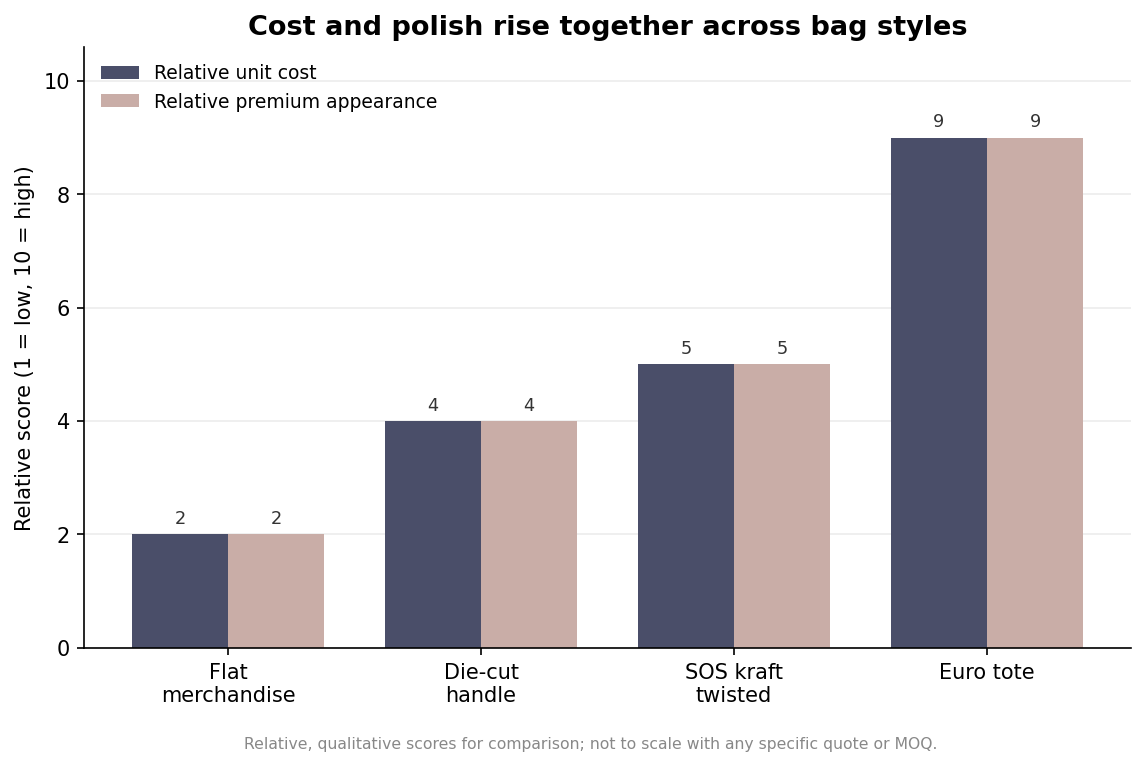
The useful insight here is that cost and polish rise together, so the real question is how much polish the occasion actually requires. Paying euro tote prices for a bag that will be used once at a trade show and thrown away is a poor trade; so is putting a flagship product in a flat merchandise sleeve that undersells it at the counter. Match the spend to how long the bag will live and how much it is doing to represent the brand.
Matching the build to the job
For boutique retail, cosmetics, jewelry, and gifts where the bag is part of the unboxing and may be reused or seen again, the euro tote earns its premium and its higher minimum. For grocery, market, takeout, and any high-volume situation where sturdiness and a natural look matter more than gloss, a twisted-handle kraft SOS bag delivers the most carrying strength per dollar. For trade shows, conferences, and one-day events where you need a printed handled bag in quantity at a controlled cost, a die-cut handle bag is usually the smart middle ground. And for apparel, stationery, and light impulse purchases handed over at the register, a flat merchandise bag does the job without wasting money on structure the item does not need. Decide the construction first, then choose size, paper weight, and handle to match, and confirm a rated load and a printing method that suits the style before you approve your sample.
Leave a Reply