The single most expensive mistake on a custom gift bag order is not choosing the wrong paper or the wrong handle. It is ordering three weeks before you need the bags in hand and discovering that a printed, laminated, rope-handled bag made overseas takes closer to three months. Lead time is the part of the process buyers underestimate most, and it is almost entirely predictable once you know which stages your order has to pass through. This guide breaks the timeline into its real components so you can plan backward from the date you actually need the bags.
The four stages every order passes through
Whatever the supplier or country, a custom gift bag order moves through the same four stages, and each one has a fairly stable duration. Proof and artwork comes first: if you supply print-ready files that meet the template, a digital proof can turn around in one to two days, but if the art needs rebuilding or the layout has to be redrawn to the die line, plan on three to seven days of back-and-forth before anyone approves anything. Sampling follows, where a physical pre-production sample is made to the approved specification; that typically runs five to ten working days, and every round of revisions adds another three to seven. Production is the long pole, usually fifteen to twenty-five working days once the sample and specs are locked, stretching past that when foil stamping, embossing, or special laminates are involved. Quality control and packing closes it out in one to three days.
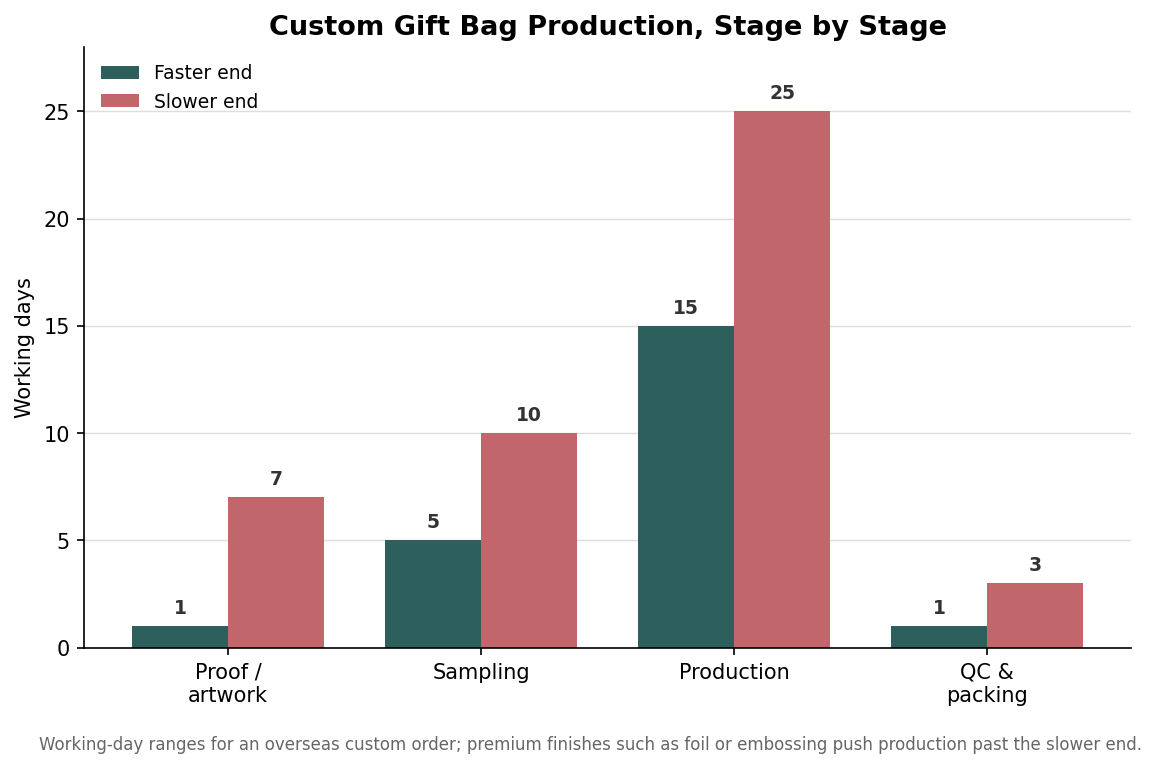
Those stage durations are working days, not calendar days, and they assume the order is not sitting in a queue behind other jobs. Add weekends, holidays, and the reality that suppliers batch work, and the honest planning number is always a little longer than the sum of the parts. It also helps to know which stage you are in at any moment, because the cost of a change rises sharply as you move down the list: a tweak during proofing is free, the same tweak after the sample is approved means a re-sample, and a change after production has started usually means starting over.
Shipping is where domestic and overseas orders diverge
Up to the point the bags leave the factory, a domestic and an overseas order look similar. Shipping is where they split apart. Express courier moves small quantities in one to five business days and air freight in roughly three to seven, but both are priced for urgency and rarely make sense for a full pallet of bags. Ocean freight is the default for bulk, and it is slow: port-to-port to the US West Coast runs about fifteen to twenty days and to the East Coast twenty-five to thirty-five, before you add customs clearance and the truck leg inland. That ocean window is why a bag that took four weeks to make can still be six weeks from arriving.
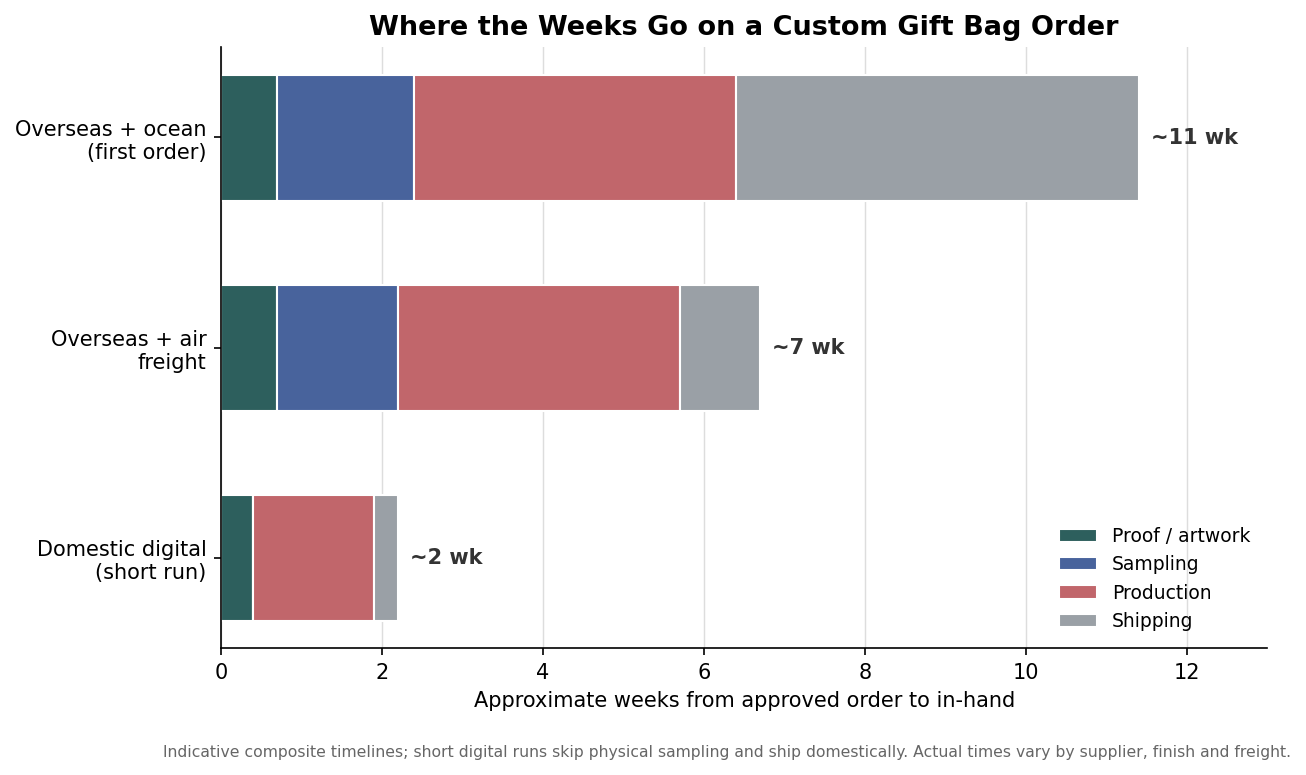
The practical takeaway is that sourcing path matters more than any single production detail. A short digitally printed run made and shipped domestically can be in your hands in one to three weeks because it skips physical sampling and ocean transit entirely. The same design produced overseas as a litho-laminated bag with a rope handle, sampled and shipped by sea on a first order, realistically wants ten to fourteen weeks, and a peak-season order competing for factory and vessel space can push to sixteen or more.
Planning backward from the date you need them
Because the stages are predictable, the smart move is to start from your in-hand date and subtract. If you need bags for a store opening or a holiday season, count back the full production-plus-shipping window, then add a buffer for the proofing and sampling that happens before the clock even starts. For a first overseas order that means committing your artwork roughly three months ahead, not three weeks. Holiday orders are the classic trap: fourth-quarter demand collides with factory backlogs and container shortages, so the same job that runs in ten weeks in spring can need fourteen in the fall. If your date is fixed and immovable, build in a week of slack for a failed sample or a revision, because a rejected proof quietly resets part of the timeline.
How to compress the timeline safely
You can shorten a schedule, but each lever has a cost or a risk. Supplying genuinely print-ready artwork that matches the die line is the cheapest week you will ever save, because it collapses the proof stage and reduces the chance of a re-sample. Approving a digital proof instead of waiting for a physical sample saves days, though it trades away your last chance to feel the paper and check the print before the full run. Paying a rush premium, often in the range of twenty to thirty percent, can pull perhaps five to ten days out of production, but it does nothing for ocean transit. And choosing a domestic digital run for smaller quantities is the most reliable way to buy speed outright, at a higher per-unit price than an overseas bulk run. The one lever you should not pull is skipping the sample on a complex bag, since a structural or color problem discovered after production is far more expensive than the time a sample would have cost.
Once you have ordered a design you intend to reorder, keep a simple reordering rule in mind: place the next order when your remaining stock covers about three weeks plus your full lead time, so a slow production run or a delayed vessel never leaves you empty. Lead time is not the enemy on a custom gift bag order. Treating it as a surprise is.
Leave a Reply